
We must build Reform Capacity into the UN’s Operating System to Break the Cycle of Empty UN Reforms
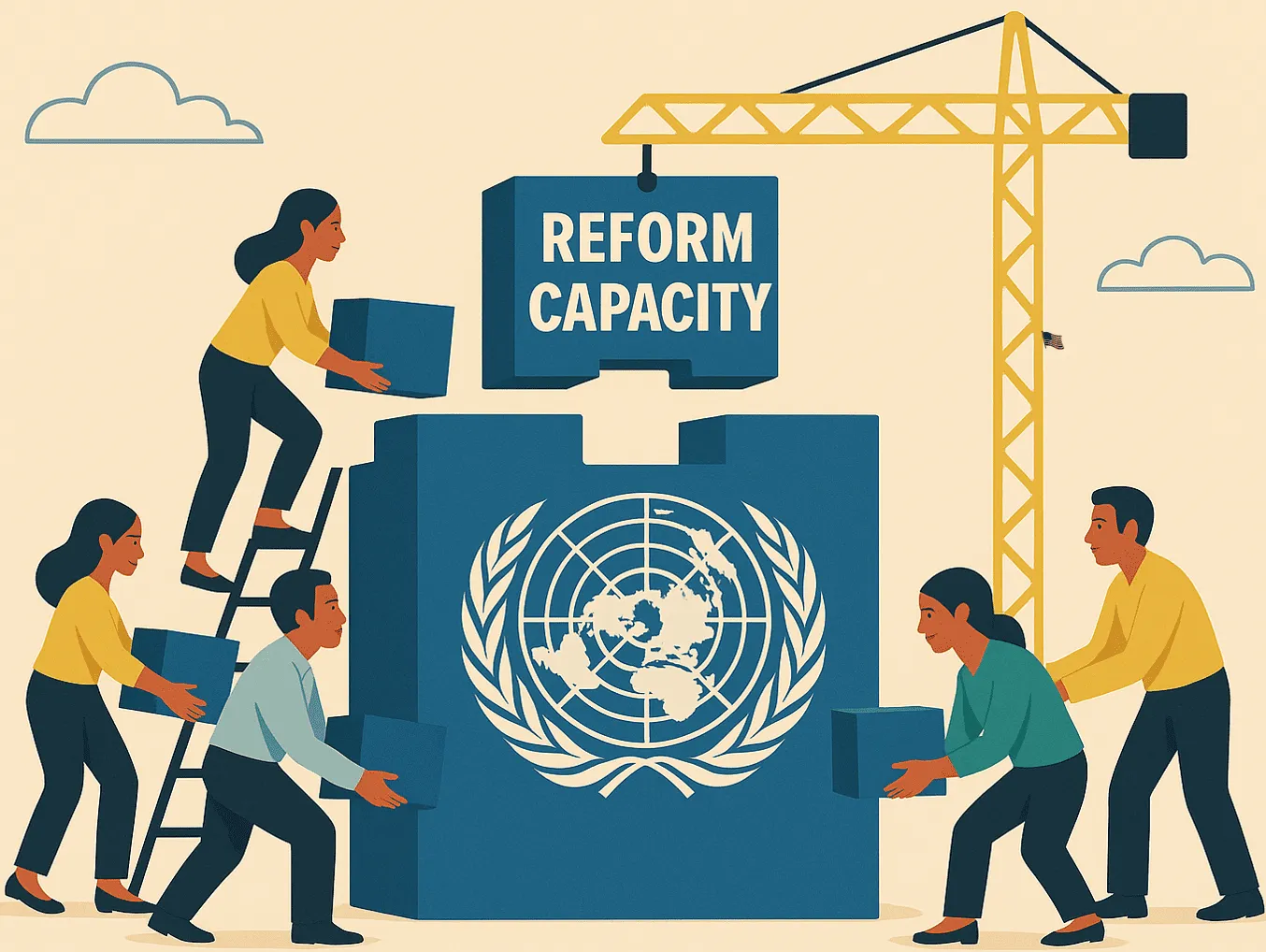
As the United Nations is turning 80, UN Secretary-General António Guterres launched the UN80 initiative, a reform plan broadly described as the boldest attempt in more than a decade. Its success will depend less on ambition than on architecture: whether the UN can finally build reform capacity into its operating system. Decades of well-intentioned initiatives—from Annan’s In Larger Freedom to Guterres’s own 2017 reforms—have faltered for the same reason: each addressed symptoms, not structure. Chronic funding shortfalls and unrealistic mandates keep the Organization trapped in a cycle of reform without transformation. UN80 will matter only if it fixes not what the UN does, but how it reforms itself.
Reform Fatigue, and Why UN80 Matters Now
Reform fatigue runs deep in New York. Kofi Annan’s 2005 In Larger Freedom was billed as a turning point but quickly diluted in General Assembly divisions. Ban Ki-Moon’s 2010 Global Field Support Strategy tinkered with back-office functions but left political and financial bottlenecks intact. António Guterres’ own three-pillar reforms in 2017 decentralized authority and streamlined budgets, yet left delivery patchy.
Each wave generated expectations, but few shifted the UN’s operating logic. Previous attempts produced valuable lessons, which evaporated when leadership changed and funding waned. Every cycle starts again from scratch.
Reform has become ritualized: it reassures member states, signals responsiveness, and provides legitimacy, but rarely changes execution. As evidenced by the recent meeting of the Informal Ad Hoc Working Group on mandate review, the problem is not ambition but absorption. UN80 will be different only if it fixes not just what the UN does, but how it reforms itself.
Why do reforms keep falling short? Two deficits explain the cycle, and one solution can break it.
The Input Problem: The Financial Deficit
The first and most visible deficit is financial: without reliable and predictable funding, reform is reduced to managing scarcity rather than building capacity.
Governments supply, directly or indirectly, nearly 90 percent of UN revenue, over two-thirds of which is voluntary (and largely earmarked), tying reform space to donor priorities rather than GA decisions. The assessed budgets have faced a rolling “perennial”liquidity crunch since 2019, and until end of October, 2025, both biggest contributors (the United States and China, together owing 42 percent of the regular budget and 50 percent of peacekeeping budgets) had not paid, leaving the GA’s funding model exposed and peacekeeping operations in disarray.
The danger is that UN80 could collapse into austerity multilateralism. Too often, “efficiency” is a euphemism for “cuts.” The Fifth Committee has institutionalized this mindset, often retreating to cost-saving by default. The current liquidity crisis is a cautionary tale. With major contributors in arrears, the Secretariat delayed reimbursements to troop contributors and froze recruitment. Instead of triggering structural fixes, it reinforced a scarcity logic: managing decline rather than building resilience. Even structural reform proposals (as part of the third workstream under the UN80 initiative) risk being reduced to an austerity agenda if member states narrow reform to accounting tricks and only see them as cost-cutting.
The Output Problem: The Mandates Deficit
The second deficit is political: mandates are adopted across UN bodies without realistic alignment to planning, resources, or deliveryin the field. The General Assembly and Security Council adopt mandates disconnected from resources and planning. Special political missions are routinely authorized without predictable financing (before 2018, they were even funded only through a general envelope instead of a proper budget), leaving field teams to improvise—or make do.
But the problem runs deeper than financing. Time and again, resolutions are inflated, contradictory, or declarative rather than prescriptive, producing “Christmas tree mandates” that sprawl without clear priorities. The result is a gap not only between mandates and budgets, but between political intent and operational feasibility. That often leaves the Secretariat overextended and member states in deadlock: political legitimacy is signaled through endless resolutions, but execution is undercut by fragmentation and underfunding.
The Solution: Building Reform Capacity into the UN’s Operating System
So far, the UN is not equipped to address these deficits institutionally. Reform remains episodic—dependent on the priorities of a particular Secretary-General or on moments of political momentum—rather than supported by standing systems able to carry change forward. The Organization lacks reform capacity: the ability to sustain improvement once attention shifts elsewhere. The real test for UN80 is whether it can weave that capacity into the UN’s operating fabric.
There are already steps in that direction: the Business Transformation and Accountability Division (BTAD), within the UN Department of Management Strategy Policy and Compliance. Created in 2017 to track reform projects and promote accountability, BTAD proves that reform capacity can be institutionalized. Its founding director now heads the budget division, at the forefront of efficiency and budget reduction, illustrating that, once reform capacity is built, it can spread and influence other core functions of the UN.
A standing function—perhaps an empowered BTAD—must track and preserve lessons, ensuring reforms build cumulatively. Other international organizations show it can be done. The World Bank’s Independent Evaluation Group and the IMF Independent Evaluation Office keep reform alive across cycles. They demonstrate that reform capacity is doable. For the UN, the challenge is political ownership: will member states allow the Secretariat to keep reform tools alive, or will each cycle once again reset to zero?
From Reform Cycles to Reform Systems
As the General Assembly is in its 80th session, member states face a decisive choice: keep reform as performance, or embed it into the UN’s operating system. That would carry three consequences:
- Stable funding: Restore primacy to assessed, predictable contributions for the Organization’s core budgets [so that reform planning is insulated from the volatility of voluntary financing].
- Realistic mandates: Align political ambition with operational feasibility: mandates should be concise, prioritized, and costed, linking political intent to planning and delivery capacities. No more declarative or unfunded promises.
- Reform memory: Create a standing function to preserve and transmit lessons across cycles.[A permanent reform capacity would ensure continuity, accountability, and cumulative progress.]
These benchmarks would mark the moment the UN80 reform finally stuck. But none of them will materialize without active member state ownership. Engagement is therefore decisive: it cannot be confined to applauding the launch of UN80 or adding rhetorical weight during “High-Level Week.” Only sustained political follow-through will give UN80 the chance to break the cycle of empty reform.
About the author
Thibault Camelli is a research scholar with the Center on International Cooperation (CIC) at New York University. He has over fifteen years of experience spanning multilateral diplomacy, finance, and international public policy, with nearly half of his career devoted to multilateral negotiations, including at the United Nations and the OECD. He previously held senior roles in the French civil service, the European Union, and the private sector.
This think piece is based on the author’s policy paper published with CIC, ”Unlocking Reform Capacity: What UN80 Reveals About the Limits and Possibilities of UN Reform,” September 2025.
The views and opinions expressed in this think-piece are those of the author and do not necessarily reflect the official policy or position of SIPA or Columbia University.