
Global Leadership in Action: Lessons from UN Secretary-General Kofi Annan
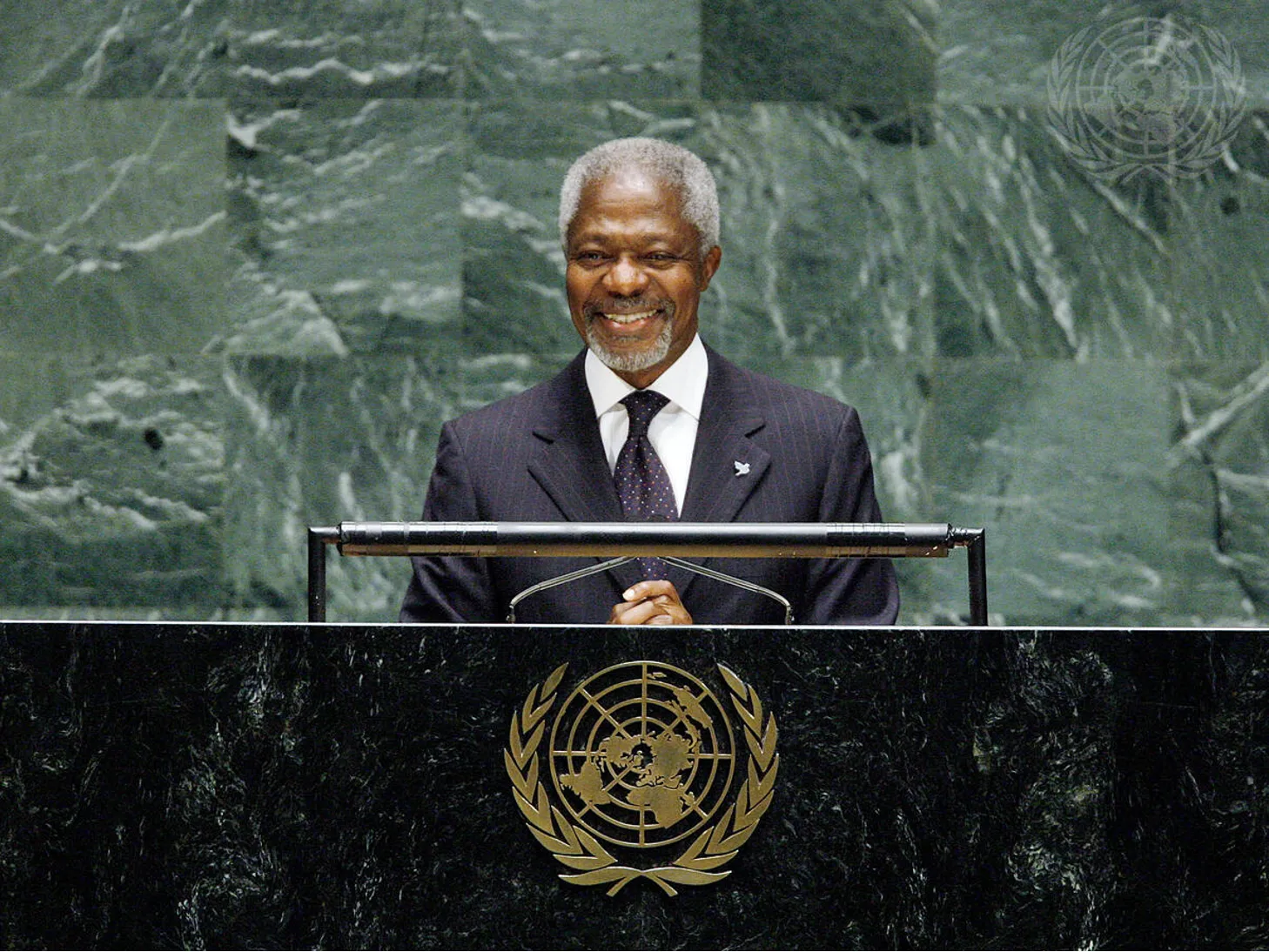
The world is facing multiple, simultaneous crises – from geopolitical conflict and economic instability to climate change and public health threats. These crises demand morally and politically courageous leadership to deliver solutions. But leaders of this caliber are scarce. Kofi Annan’s leadership as UN Secretary-General at another turbulent moment in world affairs provides enduring lessons for today. My book, Kofi Annan and Global Leadership at the United Nations (Oxford University Press, 2024) traces the formidable global challenges Annan handled skillfully during his ten momentous years at the helm from 1997 to 2006, while also overseeing institutional reform and expanding the UN’s partners beyond states. He combined a realistic humility about the UN’s purposes with bold and visionary leadership thereby maximizing the organization’s potential where it had a special role to play. Annan kept the UN central to international diplomacy and norm-setting. Although the UN is an organization of states, he stressed that it was founded in the name of “We the peoples” and placed peoples’ rights and needs at the center of the UN’s action. His leadership reminds us that realism about the UN’s deficiencies does not entail fatalism about the opportunities it presents.
Global leadership can be exercised without hard power
Unlike national leaders, Annan did not control any territory or armies, made no laws, and imposed no taxes. He based his leadership on respect for the UN Charter, moral authority, legitimacy, persuasion, and agile diplomacy. By speaking consistently about human dignity, human security, shared humanity, and collective responsibility he influenced how states understood their own interests. He engaged in a continuous process of negotiation and coalition-building, reflecting a realistic understanding of how international cooperation works. Annan’s calm and measured style meant that world leaders listened even when they disagreed. He demonstrated that in global politics, credibility, ethical consistency, and trust can shape outcomes in ways that coercion cannot.
Sovereignty is a responsibility, not a shield for atrocities
One of Annan’s most important ideas was redefining sovereignty. For decades, sovereignty had served as a shield, allowing governments to abuse their own people. Annan argued that sovereignty entails the responsibility of a state to protect its citizens against extreme human rights violations and that when a state fails to do this the UN may need to intervene. This thinking laid the foundation for the Responsibility to Protect (R2P) which maintains that collective action should be taken by the UN to prevent or halt genocide, war crimes, ethnic cleansing and crimes against humanity. Although its implementation has been inconsistent and controversial, R2P marked a watershed in global norms about human protection. And it is often at the center of debates of whether, how, and when to intervene to protect populations from atrocity crimes.
Security, development, and human rights are inseparable
Annan believed the UN’s main purposes could not be separated. As he wrote in his report In Larger Freedom, “We will not enjoy development without security, we will not enjoy security without development, and we will not enjoy either without respect for human rights.” He oversaw the deployment of UN peacekeepers to stabilize states like Burundi, and help build new ones, like Timor-Leste. He took risks to defuse crises, reinforcing the UN’s role as a trusted mediator. In 1998, he traveled to Baghdad to meet with Iraqi President Saddam Hussein in an effort to avert armed conflict in the Middle East. His adroit mediation over several years prevented a war between Nigeria and Cameroon over the disputed Bakassi Peninsula. At his urging, UN member states established the Peacebuilding Commission to support countries in building peace after conflict. He championed the creation of the Human Rights Council which he saw as essential to restoring the UN’s moral authority on human rights. Annan launched the Millennium Development Goals (MDGs): a set of clear, measurable targets for the world to achieve by 2015, including reducing extreme poverty, promoting gender equality, improving maternal health, and halting the spread of HIV/AIDS. The MDGs reflected Annan’s conviction that hunger, disease, and inequality destabilize societies as much as armed conflict. The MDGs also showed that global cooperation around shared goals can move the needle on big problems and laid the foundation for today’s Sustainable Development Goals.
The UN must build innovative partnerships with non-state actors to achieve its mission
Annan recognized that governments alone cannot solve global problems and the UN needed to engage with non-state actors. So, he built partnerships with civil society and – in the starkest departure from his predecessors – the private sector. He founded the Global Compact which has become the world’s largest initiative to promote corporate social responsibility. He spearheaded the creation of the Global Fund to combat HIV/AIDS and persuaded the CEOs of the leading pharmaceutical companies to make antiretroviral drugs available in developing countries at affordable prices. He changed the UN’s relationship with the private sector from one of confrontation to one of cooperation. This openness to new constituencies and ideas sparked useful ferment within the organization. And by legitimizing non-state actors as partners rather than outsiders, Annan helped redefine who participates in global governance.
The UN Secretary-General must speak to a global public
As the communicator-general, Annan understood that a modern Secretary-General must reach a global public far beyond the halls of the UN and the ranks of world leaders and diplomats. He used the bully pulpit to articulate a global agenda, speak out on specific crises, mobilize different coalitions to help the UN in its work, and build public support for international cooperation. He made the case for multilateralism in clear and persuasive language that resonated with ordinary people not just leaders. Moreover, he affirmed that global institutions and universal norms are not a threat to peoples’ particular identities or interests. As a public figure, Annan captured the global imagination, humanized the UN and represented its principles and ideals to the world.
Ethical, principled, people-centered leadership matters
As I explain in my book, Kofi Annan’s leadership shows that ethical, principled, people-centered leadership matters. He challenged the assumption that leadership depends on hard power to be transformative. He framed global problems in ways states and other actors could not ignore. And Annan demonstrated that progress is achieved through sustained consensus-building that aligns moral arguments with political realities.
About the author
Abiodun Williams is Professor of the Practice of International Politics at The Fletcher School of Law and Diplomacy and The Tisch College of Civic Life at Tufts University. He was Director of Strategic Planning for UN Secretaries-General Kofi Annan and Ban Ki-Moon. He is a former Chair of the Academic Council on the UN System (ACUNS).
This think-piece is based on the author’s book Kofi Annan and Global Leadership at the United Nations (Oxford University Press, 2024).
The views and opinions expressed in this think-piece are those of the author and do not necessarily reflect the official policy or position of SIPA or Columbia University.
Photo Credit: UN Photo/Paulo Filgueiras