
Sino-centric Multilateralism: China’s Order-Building in the Post-Liberal Order
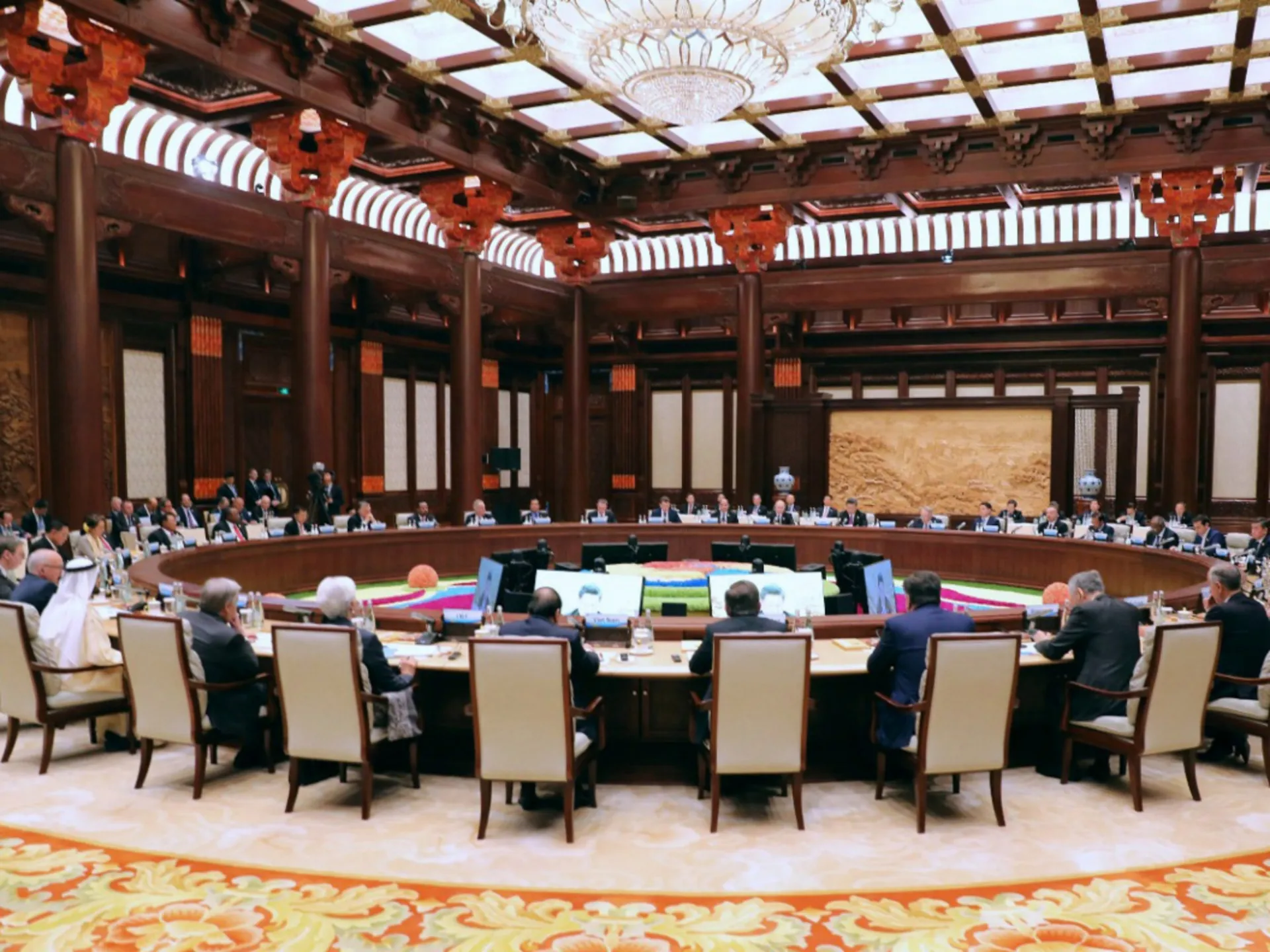
Since 2025, the US has defunded its international commitments and withdrawn from several multilateral agreements and organizations. Both alarmist and hopeful voices have suggested that China would fill this role: alarmist if they feared the clash of China’s political values with liberal democratic ones; hopeful if they saw an opening for greater Global South representation at the global governance table.
Yet in some ways, both hopes and fears have been dashed as it emerges that China is not replacing the US in the international system. It is, however, creating deep global relations that are often greatly underestimated, and these point to how multilateralism will operate after the liberal international order (LIO).
Our new book, The Dragon’s Emerging Order: Sino-centric Multilateralism and Global Responses, examines what China actually has been doing – starting long before the US foreign policy shift against multilateralism. In this era of short, headline-oriented attention spans, it’s important to take a long view of things. This isn’t just because new initiatives need to be judged on results rather than press releases, but because order-building is inevitably a slow and uneven process.
While current US foreign policy may have destabilized the multilateral pillars it built, it has had far less effect on other states’ multilateral projects. And by the same token, paying close attention to China’s long project shows prospects at odds with more attention-grabbing headlines that suggest that the world is there for China’s taking.
What is Sino-centric Multilateralism?
‘Sino-centric multilateralism’ involves the multilateral meetings China either created or plays a central role in, and was first observed by others in a variety of formats. China has sought to depict its approach as ‘true multilateralism’, insinuating that others’ versions are false to protect its approach while dismissing others, so we also wanted to study whether there were Chinese characteristics it was imbuing in its multilateral policies.
We took as a starting point what was explicitly Sino-centric through their very structures: The Chinese-oriented regional summits such as the Forum on China Africa Cooperation (FOCAC), the China-Community of Latin American and Caribbean (CELAC) Forum, and the ASEAN-China summit, among others. We then added cases of global significance, such as the Belt and Road Initiative (BRI), G20, and G77, which offered perspectives about China’s interactions in looser multilateral settings.
Considering the theory and practice of Sino-centric multilateralism involves a study of what multilateral norms China espouses, and to what extent they’re universal or imbued “with Chinese characteristics”. China’s conception of a “harmonious world” and self-conception as a benevolent state do offer an ideal end-state that few have tried to apply, but should not be dismissed out of hand.
Relating with universal norms, China explicitly draws from the UN Charter and foundational agreements like the China-India Panchsheel agreement from which the “Five Principles of Peaceful Coexistence” are derived. On the other hand, what China chooses to emphasize – repeatedly – is driven by its competition with the US. Denouncements of “cold war mentality”, “bloc politics”, “hegemonism”, or similar refrains originate from its Cold War non-aligned posture, but are now regarded as anti-Western rhetoric.
China’s normative positions should then be compared against actual initiatives, such as its early interactions with ASEAN and the ‘Shanghai Five’ (which eventually became the Shanghai Cooperation Organization (SCO)) in the 1990s and 2000s. Altogether, this results in a global survey of China’s multilateral initiatives and gives a much broader analysis of the strategic overlay of China’s foreign policy than is usually found in regional or bilateral studies. It shows clear coordination and consistency, as well as the depth of engagement (i.e., the resources put behind it), which explains why China enjoys widespread support around the world, despite criticism in the West.
Global South Views and Agency
One of the difficulties with Western discourses about China is that the historically antagonistic relationship has made it difficult to arrive at nuanced understandings about both its potentials and its problems. This meant taking not only a look at China’s actions, but the views of different actors who partner China. For that reason, we must assess success or failure at the conjunction of both sets of interests.
That means looking at what those partners were seeking, and to what extent they were getting those goals out of the relationship. If there is a genuine “win-win” outcome, these would result in enduring cooperation that could genuinely become building blocks for a different kind of order. If differences cannot be resolved, then the formats would hit diminishing returns, and it is difficult to envisage how they would develop further.
In studying its regional engagements, China’s initial impetus was often simply to multilateralize its numerous bilateral relations which would be logistically impossible to conduct while following diplomatic protocols (that demand peer-to-peer meeting) with hundreds of countries around the world.
Rather than overestimate China’s sway in these formats, as diplomatic communiqués might indicate, frictions are characteristic of diverse national positions that stress regional cooperation, so attention should be focused on how these were managed or resolved (or not). The greatest test of China’s potential as a global leader may lie in its ability to resolve issues when interests clash.
The US-led LIO was built initially in opposition to communism, and then later in support of trade liberalization, human rights, and democratization. Post-World War 2, the US encapsulated its approach as “liberal internationalism”, a universalist doctrine that espoused norms like the sovereign equality of states, which enjoy wide buy-in from newly independent states (and whose historical recency is often underestimated).
China now is acting in analogous fashion with four Global Initiatives (Civilizations, Development, Security, and the latest, Governance). Yet much like the trenchant critiques of the hypocrisies embedded in the LIO, the test of China’s Initiatives will come from the interplay between these high-minded norms and the live conflicts and disputes China faces with other states.
Moreover, analysis of the demand side of the equation shows there is plenty of room for agency from partner states. They outnumber China in these formats, and their ability to define regional agendas is significantly stronger. While China’s engagement with the Central and East European states has fallen, it remains strong with other parts of the world because its partners also deem the interactions to be beneficial.
Implications and Takeaways
First, it’s not clear that China is ready or willing to replace the US. Sino-centric multilateralism started long before US retrenchment from multilateralism, but has relatively modest aims when juxtaposed with the LIO. Moreover, the resources needed to create an order as extensive as the LIO far exceeds China’s forays, and it has not shown intentions of greatly increasing those commitments so far.
Yet China’s engagement with partners is far deeper and more strategically coordinated than frequently recognized. This means that rhetoric (such as “debt trap diplomacy” accusations) and countercoalitions will be insufficient for isolating or even balancing China’s forays. Those who wish to present China as a “threat” will have to do more substantive engagement with other countries if they want their message to sell.
The US recently held its first Critical Minerals Ministerial, attended by some 54 countries including 43 at ministerial level. Several MOUs were signed, and attendees included very non-conventional potential US partners, especially from Central Asia. Like China, it appears to be following the practical logic of the need to multilateralize the numerous bilateral relations despite Trump’s disdain for conventional multilateralism, and this may be a sign of how multilateralism will evolve.
Sino-centric formats do not follow a Western model of greater rules-based institutionalization, such as creating codes and charters. Instead, they remain informal, peer-based engagements, where the summit remains the apex of interaction. This has both strengths and drawbacks – good because all manner of issues may be negotiated as needed; bad because the systems’ sustainability and predictability may not be assured and require constant renegotiation.
The cohesion of the ‘West’ is dissipating due to US unreliability or even directly hostile actions. Once closely aligned states have sought to recalibrate their positions in response. However, the political debates in these states have struggled to find a nuanced framework on the prospective role of China in their international relations, having been antagonistic for so long.
But there are other states that have had longstanding relations with China. They face both opportunities and risks – even actual conflicts – when it comes to managing their bilateral relationship. These include China’s neighbors in Asia, as well as states that reached out cross-regionally from Africa and Latin America. As the “West” grapples with finding a new modus vivendi with China, it may be timely to look at how Global South states have done it. They have faced greater power asymmetries yet found “win-win” arrangements of mutual benefit and with far less sacrifice of national agency than is usually presumed. If this is one of the alternatives for the reshaping of the international order, the clearest signal of its viability will be assessing how enthusiastic those within it are.
About the author
Dr Joel Ng is senior fellow and head of the Centre for Multilateralism Studies (CMS), S. Rajaratnam School of International Studies (RSIS), Nanyang Technological University (NTU), as well as co-chair for Singapore in the Council for Security Cooperation in the Asia Pacific (CSCAP). The Dragon’s Emerging Order: Sino-centric Multilateralism and Global Responses (World Scientific, 2026) is now available.
The views and opinions expressed in this think-piece are those of the author and do not necessarily reflect the official policy or position of SIPA or Columbia University.
Photo credit: Alfred Frias/Presidential Photo, Wikipedia Commons