
A New Vision for the United Nations
To seek the office of Secretary-General is to declare a deep and abiding faith in the United Nations – its principles, its purpose, and its potential. It is to work with tens of thousands of people who give this institution life every day: peacekeepers, field staff, diplomats, experts and policy makers.
But across the world, trust in the UN is waning. We owe it to the governments and people we serve to recognize and rise to this crisis of faith. To defend the UN is to have the courage to change it.
It took courage to create, out of the ashes of a devastating world war, an organization dedicated to peace and security. It took courage to refuse to normalize human suffering when it was everywhere to be found. The UN Charter embodies that courage and our mandate.
Our founders understood that preventing war means more than opposing it. It requires building the conditions for peace to hold – development, human dignity, and international law.
In eight decades, the UN and the nations it serves have made huge strides toward peace that holds, lifting billions out of poverty, delivering emergency relief, protecting fragile ceasefires and building frameworks of cooperation that deliver shared benefits.
But the UN will not be judged by what it has done, but by what it can do.
Today, we are falling short. Too many think that the UN is absent from negotiations to end wars. It is seen as too distant from the daily needs of people, focused on reports that few read and meetings that few notice. Too many no longer believe in the UN’s capacity to deliver peace or development. None of this is easy to say. Not all of it is true either. But in an age of growing distrust, we must listen and face this reality or be swept aside by it.
New powers are emerging, geopolitics and geoeconomics are becoming one, and the risk of fragmentation — between blocs, systems, visions of the future — is real. Armed conflicts are at their highest level since 1945. Societies that were once defined by aspiration are losing faith in it. Technology is crossing awesome, but possibly perilous, frontiers. We are sleepwalking into dangerous climate change scenarios. Far too many remain displaced, excluded from opportunity.
The paradox is that we command more knowledge, more wealth, and more capacity today than any generation in history. Many states are achieving extraordinary economic and technological milestones. Nations are extending the lives and wellbeing of their citizens, creating new opportunities for inclusion. Civil society and the private sector are finding solutions to problems that once threatened humanity. We have the means to build a better world. The question is whether we have the collective will to do so together and to overcome the fragmentation that threatens our future.
This is where the UN’s purpose lies. Its role is not to impose the world’s direction, but to widen the space for joint action; not to abolish disagreement but to find common ground; to help craft solutions, not to dictate them.
Today the UN confronts a political, a legitimacy and an operational crisis. If elected Secretary-General, my task will be to chart a path of renewal, to make the UN more useful, more agile and more accountable to the governments and people it serves. As steward of the Organization, I can only do this by working with all Member States, in full compliance with the Charter, with humility, integrity, and impartiality.
Renewal means refocusing on our purpose, delivering results and building for the future. As Secretary-General, I will propose to make these my three priorities.
I. Refocusing on our purpose: Durable Peace and Security
Back at the Table
As Secretary-General, my priority will be to restore confidence in the UN as a trusted convener in theatres of conflict. This means revitalizing the good offices of the Secretary-General as an impartial steward of peace: facilitating exchange, prioritizing early engagement and quiet back channeling, investing political capital in preventive diplomacy and thoughtful mediation before positions harden and violence escalates. It means rebuilding trusted spaces for dialogue and engaging all parties. It means being at the table when others leave. It means putting forward options that may be rejected and persisting even when progress appears out of reach.
Wars do not wait for perfect conditions. Nor should diplomacy.
I know this firsthand. At the start of the war in 2022, grain exports were frozen in the Black Sea. Around the world prices rose and food insecurity intensified. On behalf of the UN Secretary-General and with the support of Member States, I was asked to negotiate and find solutions. After months of work, two agreements were brokered between the UN, Türkiye, the Russian Federation and Ukraine, and between the UN and the Russian Federation. The Istanbul agreements were signed. Implementation required knocking on every door: working with governments, with banks, with shipping companies, with insurers and traders. Once the deals were in place, global food prices fell by 23 percent, stabilizing markets and preventing social unrest and political instability across multiple regions.
That experience taught me what the UN can achieve when it stays at the table, through quiet diplomacy, supported by a small team with the right expertise, flexibility and agility.
Building the infrastructure for peace
Good offices are not enough. The UN must be able to respond as fast as crises unfold. That means mediation capacities that are properly resourced, rapidly deployable and shaped not by the pace of the institution but by the needs on the ground. This requires mediators with deep understanding of each context, the willingness to listen to all sides and the humility to recognize that solutions may lie among those closest to a conflict.
Peace is never a solitary endeavor. It takes many forms: national leaders working to defuse tensions, regional organizations mobilizing mediation initiatives, coalitions of countries complementing and reinforcing each other’s efforts, humanitarian workers and local mediators risking their lives under fire, religious leaders carrying messages of reconciliation and private enterprises supporting reconstruction. As the only forum where all Member States meet in sovereign equality, the UN brings unique legitimacy to conflict resolution initiatives. It must become more effective in connecting and amplifying the peacemaking of others.
New tools can also help — from data-driven early warning systems to AI-assisted analysis that identify risks before they escalate. The UN must embrace these capabilities not as experiments but as core operational assets.
Peace operations are one of the most vital tools that the UN can contribute to helping national, regional and local actors create the space for conflict resolution. I am committed to crafting a new vision for UN peace operations, one that works hand in hand with partners to prevent the escalation of violence, protect civilians, and create the conditions for peace and recovery.
That same shared purpose must also extend to rebuilding the foundations of international security in the twenty-first century. The last remaining nuclear arms control treaty between major powers has lapsed, and consensus on non-proliferation is eroding. The frameworks that kept chemical and biological weapons in check face intensifying pressure. New technologies - autonomous systems, cyber capabilities - and new domains of strategic competition - outer space - create risks our frameworks were not built to handle. Threats that wear no uniform such as organized crime, terrorism, drug trafficking, illegal arms flows - fuel insecurity and corruption, eroding public trust and destabilizing entire societies. Many countries, including in my region, are not at war but lose hundreds of people to violence every day.
The UN must help craft responses to the security challenges of today. Stability without development is stagnation. Security without opportunity cannot be sustained. The UN’s founders understood this: they put peace, respect for human dignity, and development side-by-side in the first article of the Charter. We need to renew that vision and restore hope in the potential of peace to deliver security, development and dignity for all.
Some look at the violence in our world today and conclude that human rights and international law have failed. I believe that a world where laws are violated is not the same as a world without laws. Violations can be named; justice can be achieved. In a world without international law, there is no recourse for wrongdoing. All governments and every citizen are responsible for upholding international law. The UN is the reflection and the expression of this collective responsibility.
The Secretary-General must actively defend these frameworks as the foundations on which peace and security depend. The dignity of every person and the rights of women and girls are inseparable from these foundations. Where rights are respected, conflicts decline. Where they are denied, grievances fester and instability follows.
The Security Council is the only body empowered by the Charter to authorize binding measures in the name of collective security, a legal authority that no other institution possesses. A Council that better reflects today's world will carry greater weight in it.
By contrast, the Secretary-General's effectiveness rests on independence and impartiality. Article 100 of the Charter binds the Secretary-General to serve the Organization alone—not any government, bloc, or ideology. This is not a constraint but a source of strength. It is a promise to every Member State, large and small, that their concerns will be heard, their interests considered, their sovereignty respected. Consistent impartiality is how the Secretary-General earns the right to speak to all.
Each UN body has its role to play, and the Organization’s effectiveness rests on their ability to work together. As Secretary-General, I will prioritize building effective relations with the Security Council, the General Assembly and its Member States. The hallmarks of my approach, in government as in the UN, will remain accessibility, transparency and responsiveness.
II. Delivering results
Becoming the partner of choice
Confidence in the United Nations will be determined by its ability to deliver results. Member States that entrust resources and political capital to the Organization are right to demand efficiency and impact. We must shift from siloed approaches to a culture of performance. Budgetary discipline and responsible allocation of resources are key for restoring confidence in cooperation.
The UN reaches people no one else can reach, in places very few go. When floods strike, when famines spread, when wars displace millions, UN staff are often at the front line. We need to harness that capacity to respond as individual agencies to one institution that delivers an effective, integrated response. People do not live hardships separately — war, hunger, displacement, disease arrive together, compound each other and demand answers that no single agency can provide.
When the UN was created, state capacity was concentrated in a few hands. That world is gone. Countries that did not exist at that time now lead regional institutions, produce world leading research, and house world-class corporations. Regional organizations have evolved into serious operational partners. The private sector deploys more capital in a quarter than the UN in a decade. Civil society connects across borders instantaneously. The UN does not need to do everything – because others can also act. The UN remains unique. But unique does not mean alone.
Three principles will define my mission, as Secretary-General, to deliver results:
(i) More useful
Reform must serve people, not process. The UN’s capacity to assist people is constrained by dispersed entities operating on different timelines, with overlapping mandates and insufficiently integrated decision-making. As Secretary-General, I will prioritize the streamlining of UN structures, align mandates, budgetary structures and implementation, so that decisions on mandate implementation are based on complementarity and not competition within the UN system. This will require discipline and oversight frameworks that I will introduce.
(ii) More agile
The UN must respond as fast as crises unfold. We need to rethink traditional planning cycles to meet the speed of global shocks and crises. Agility requires flexible funding, rapid decision-making, and streamlined coordination across entities. We need to reward, not resist, operational mindsets and solutions that challenge business as usual. Integrating AI and data-driven analysis in UN operational systems will be a critical component of my reform agenda to support more targeted and efficient responses.
Agility also enables partnership. To work effectively with states, regional organizations and stakeholders on the frontline we must engage partners in our planning and operations, sharing information on the ground: it is time to stop treating collaboration as sui generis and integrate partnership protocols into the UN’s operational toolbox.
(iii) More accountable
The UN must be an institution where effectiveness is recognized and underperformance has consequences. As Secretary-General I will commit to transparent, merit-based and geographically equitable appointments. I will uphold a zero-tolerance for sexual exploitation, abuse or any unethical conduct. This is not a matter of fairness but of legitimacy. Accountability is why I have chosen to step away from the Organization during the Secretary-General’s campaign and why I will insist on a senior leadership team reflecting the standards we promote.
Transparency and accountability are not administrative labels; they are central to operational impact. I will introduce clear metrics, public reporting, and independent evaluation so that results are measurable. Effective communication should be a dialogue, and it is critical. The UN faces a crisis of perception. We need to focus on the core of our story, engage with people and in formats, languages and platforms that people use.
A major reform effort is already underway across the UN system. Reform is possible. I have done it in every institution I have led and as Minister and Vice-President of my country: through Costa Rica’s severe debt crisis, the overhaul of national economic policy and the implementation of social programs. It requires clarity about the mission, honesty about what is failing, resolve to deliver and leadership to bring people along. As Secretary-General, I will make it my personal responsibility to drive reform that delivers real change.
But no reform can succeed on drive alone. The United Nations faces a financial crisis that requires structural solutions. Securing a stable financial foundation is a shared and urgent responsibility between the Secretary-General and Member States.
III. Building the Future
Every generation carries a simple, powerful expectation: that their children will live better than they did. In many parts of the world, that expectation is breaking down. Young people today are entering economies that offer them less than their parents. They inherit a more hostile climate. They scroll through futures that seem to close rather than open.
The next Secretary-General will serve during what may be the most transformative decade in human history. Changes now underway are as profound as they are fast, as full of risk as they are of promise. The United Nations must engage with that duality — with openness, with balance, and with the conviction that the future is not something to be feared but something to be shaped, together, for the benefit of all.
AI is moving faster than any technology in history, reshaping economies and societies, militaries, information systems, the nature of work itself. The UN has begun to address these issues. In doing so we must engage with those at the pioneering edge of change in order to harness the technology that is transforming our world. We must accelerate its diffusion to ensure that digital divides do not further expand, and that youth, communities and governments are empowered to benefit from technology.
Cyberspace has become a critical domain of activities for all nations, yet attacks on hospitals, grids and financial systems are now frequent. The gap between the pace of threat and that of diplomacy grows wider. The UN must provide a space for dialogue for constructive solutions.
Biotechnology is entering territory with questions we have not begun to answer—about human enhancement, synthetic biology, the engineering of life itself. Many of the most dangerous and intractable diseases are now close to being defeated. The UN must be where science and policy meet and evidence trumps rhetoric to drive solutions.
Technology offers new paths to development. Clean energy is growing faster than anyone predicted, signaling a future of affordable, abundant, reliable energy. Critical minerals are becoming as valuable as oil. The digital economy allows talent to compete regardless of where people live. The routes to development are multiplying and the UN must rethink how it supports countries on their development path.
At current trends, many will continue to live in crushing scarcity and face compounding crises: small island states hit by cyclones that grow fiercer each year, landlocked nations facing the brunt of rising trade costs, developing economies servicing debt while capital moves past them. Many states, including middle income countries that are home to most of the world’s poor – struggle to fully access the trade, finance, technology and investment opportunities of the global economy. The UN must help widen the pathways to economic opportunities and help remove the structural constraints that stifle people’s potential. Sustainable development is not given, but unleashed.
Step back, and a picture emerges. It is the potential of opportunity for humanity. Enough energy for everyone. Enough knowledge for anyone who seeks it. Enough capacity to solve diseases that have crushed societies for centuries.
The central question of our time is whether abundance will be humanity's common inheritance, or its deepest divide.
Without deliberate steps to unlock opportunities for all, we will struggle to answer it. No country, no matter how advanced, can navigate this world alone. The United Nations must be the space where answers are found. Not to control the future. Not to slow it down. But to ensure that humanity – in all of its diversity and scale - will be its beneficiary.
A Final Word
The founding of the United Nations eighty years ago is one of the greatest achievements of humankind. No amount of skepticism should make us overlook that.
It was not created at a moment of optimism. It was created when trust had collapsed and destruction was raw. Our founders could not guarantee success, yet they chose cooperation. What sustained them was not certainty, but the conviction that dialogue, however fragile, could create a path to recovery. They did not have certainty or trust, but they had hope.
My own path leading up to this moment reflects what the United Nations means to me.
My parents barely survived World War II. To me the Charter is more than a mandate – it is a standing warning against the perils of dehumanization, distrust, and fragmentation. My parents arrived in Costa Rica with nothing. A small country with no army took them in and, decades later, entrusted their daughter with national leadership. My own life rests on the decision of my country to invest in its people and in the multilateral system, as well as on the courage of my parents to believe that a better life was possible. They were right. I have spent my life seeking to live up to that courage.
The United Nations belongs to its Member States and to the people it serves. The Secretary-General is only one of its stewards. But stewardship, at this moment, requires more than continuity. It requires the willingness to listen when the truth is uncomfortable, to propose new ideas when the room resists, to persist when others leave.
It requires the courage to change.
About the author
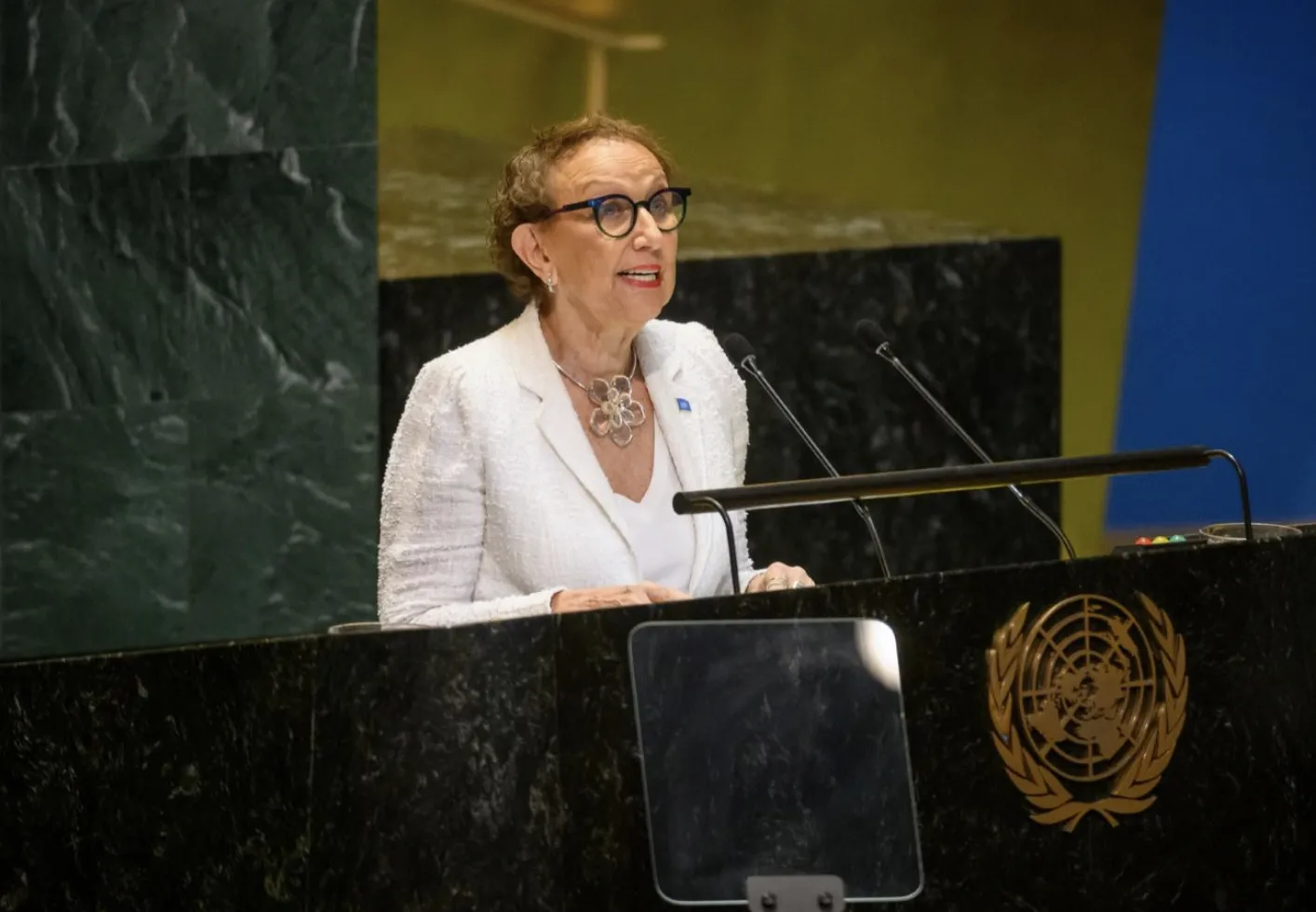
Rebeca Grynspan, candidate for UN Secretary General, is a former Vice President of Costa Rica and a global leader with extensive experience in the UN and multilateral organizations.
Currently Secretary-General of UNCTAD (on temporary leave), she previously served as UN Under-Secretary-General and Associate Administrator of UNDP, and led the Ibero-American General Secretariat (SEGIB). Expert in macroeconomic policy and trade, she is known for strategic leadership and building effective global partnerships.
The views and opinions expressed in this think-piece are those of the author and do not necessarily reflect the official policy or position of SIPA or Columbia University.
Photo credit: UN Photo/Loey Felipe