
Debt Swaps, Multilateralism, and Search for Innovative Financing Solutions

The search for innovative financing solutions is intensifying as developing countries confront a daunting fiscal reality. Climate adaptation, biodiversity protection, and the broader Sustainable Development Goals require vast investments—estimated at about $2.7 trillion annually by 2030 for developing countries excluding China. Yet many of the countries most vulnerable to climate change are also among the most constrained fiscally. High debt burdens and rising borrowing costs are forcing governments to divert scarce resources toward debt service rather than development priorities.
In this context, sovereign debt swaps—particularly debt-for-nature and debt-for-development swaps—have re-emerged in global policy debates as a possible way to reconcile debt sustainability with urgent environmental and development goals. In a debt swap, a government (sovereign) exchanges its outstanding debt for new, often cheaper debt, often with special commitments to invest in specific policy areas, such as conservation, climate change, or social development. High-profile transactions in Ecuador, Gabon, Côte d'Ivoire, and Egypt have revived interest among policymakers, international financial institutions, and multilateral forums. But can debt swaps truly help close the climate and development financing gap? The answer lies somewhere in between.
Why Debt Swaps Are Back on the Agenda
Debt swaps are not new. They emerged during the sovereign debt crises of the 1980s and 1990s, when countries negotiated debt exchanges or buybacks to reduce burdens or redirect payments toward social programs. Modern versions have evolved in response to today's twin challenges of debt sustainability and climate finance.
In a typical debt-for-nature swap, a country buys back or restructures existing debt—often with credit guarantees from multilateral institutions or development finance agencies—and commits the savings to conservation or climate-related spending. In debt-for-development swaps, the redirected funds support priorities such as education, infrastructure, or health.
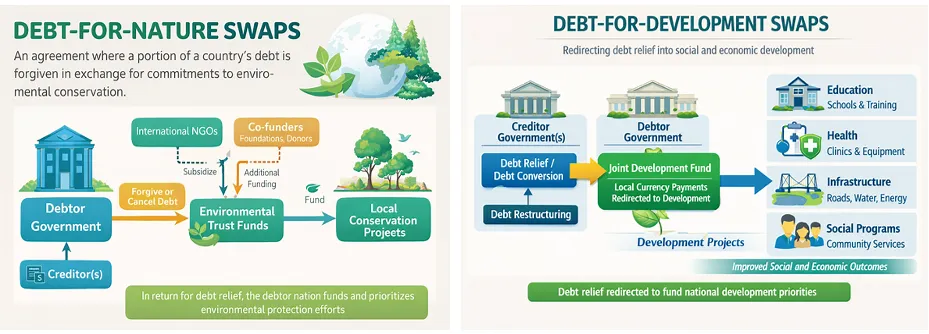
The appeal is straightforward: these instruments link debt relief with long-term investments in sustainable development. This dual objective explains why debt swaps have become prominent in UN, G20, and international financial institution discussions. The UN Secretary-General has endorsed scaling up debt-for-climate swaps, and recent 4th International Conference on Financing for Development discussions called for a debt swap for development hub to expand and coordinate such initiatives. Yet enthusiasm must be tempered with realism.
What Recent Country Experiences Reveal
Recent research by The G-24 Secretariat provides valuable insights into both the opportunities and limitations of these instruments. Ecuador and Gabon implemented large debt-for-nature swaps linked to biodiversity protection - Ecuador focused on the Galápagos Islands, Gabon on marine ecosystems along the Atlantic coast. Both relied heavily on credit guarantees from development finance institutions, which helped lower borrowing costs and attract investors, allowing governments to issue new bonds to repurchase older, more expensive debt. The resulting fiscal savings were directed toward conservation, while improved debt profiles helped reopen access to international capital markets. In Ecuador’s case, the swap retired $1.6 billion in international bonds and replaced them with $656 million in new debt, reducing the country’s debt stock by nearly $1 billion. With credit enhancement and de-risking support, the new debt’s lower interest rate is expected to cut debt-service costs by about $1.1 billion through 2041 (roughly 0.8% of 2023 GDP) and generate $450 million for conservation in the Galápagos Islands.
However, these market-based swaps were complex and expensive to structure, involving multiple financial intermediaries, offshore special purpose vehicles, and extensive monitoring arrangements. For countries with limited administrative capacity, replicating such structures may prove difficult.
Other countries took a simpler approach. Côte d'Ivoire and Egypt implemented debt-for-development swaps through bilateral agreements with official creditors—Côte d'Ivoire focusing on education, Egypt linking swaps to its Vision 2030 development strategy. These arrangements were less financially intricate in structure, but more operationally straightforward, relying on existing public financial management systems. They may offer a more replicable model for many developing countries. In the case of Cote d’Ivoire, the swap transaction generated an estimated savings of €330 million over a 17-year period (2023–2040). The savings from reduced debt service were earmarked for constructing more than thirty new schools and expanding educational access for an estimated 30,000 students, primarily in underserved areas.
The key lesson across all cases: the effectiveness of a debt swap depends less on its size than on its design and context.
The Promise—and Limits—of Debt Swaps
Debt swaps can deliver real benefits. They can create targeted fiscal space for climate or development programs, improve debt management and liability structures, and mobilize private capital when supported by multilateral guarantees.
Yet the limitations are equally clear. The scale of these transactions remains small relative to the enormous financing needs associated with climate change and sustainable development - even the largest swaps represent only a fraction of a country's total debt stock. For example, 2024 witnessed the most significant growth in sovereign debt swap for low- and middle-income countries, with nine transactions reaching a combined value of $6.8 billion in refinanced debt, and roughly $2.1 billion in new funding for nature, climate, and development objectives. Yet, in the same year, developing countries paid a record $415 billion in interest alone, according to the World Bank.
In addition, funds generated are typically earmarked for specific projects, limiting governments' flexibility to allocate resources across broader priorities. And most importantly, debt swaps cannot resolve systemic debt crises. When countries face unsustainable debt burdens, comprehensive restructuring remains necessary. Swaps can provide tactical fiscal relief, but they are not substitutes for structural solutions.
What the Multilateral System Can Do
If debt swaps are to play a more meaningful role in global financial architecture, several changes are needed.
Multilateral development banks should expand their role in providing guarantees and credit enhancements, which can significantly lower borrowing costs and attract private investors. Swaps should also be embedded within national development and climate strategies rather than tied narrowly to individual projects, enhancing country ownership and reducing administrative burdens. Finally, debt swaps should be viewed as one element of a broader reform agenda that includes improving access to concessional finance and strengthening sovereign debt resolution frameworks.
Standardization is particularly important. At present, each swap transaction is structured from scratch, involving complex legal and financial negotiations. The centralized platform endorsed in the Sevilla Compromiso is now operational at the World Bank. It could develop templates, best practices, and monitoring standards that make transactions faster, cheaper, and more transparent. This could help address several of the practical barriers that currently limit the use of swaps. By providing technical support, standardized frameworks, and coordination among creditors, the facility could reduce transaction costs and make swaps more accessible to a wider range of countries.
Multilateral development banks could also expand the use of credit guarantees and risk-sharing instruments that have proven critical in recent swaps. These tools can significantly lower borrowing costs while crowding in private investment.
Yet even a well-designed debt swaps hub will not solve the underlying challenges of the global financial system.
A Useful Tool—But Not a Silver Bullet
The resurgence of sovereign debt swaps reflects growing recognition that traditional financing mechanisms are insufficient for today's global challenges. Properly designed, swaps can help countries create fiscal space, mobilize resources for environmental protection, and strengthen debt management. But they are not a silver bullet. Their greatest value lies in complementing broader reforms of the international financial system. Lasting solutions will require deeper changes to the global financial architecture—of which debt swaps are a promising, but limited, part.
About the author:
Iyabo Masha is Director and Head of Secretariat of the Intergovernmental Group of Twenty-Four, The G-24. This article is based on the G-24 Special Report From Galapagos to the Gulf of Guinea: Policy Lessons from Sovereign Debt Swaps in Ecuador, Gabon, Cote D’Ivoire and Egypt.
The views and opinions expressed in this think-piece are those of the author and do not necessarily reflect the official policy or position of SIPA or Columbia University.
Photo credit: The image was made with Chat GPT