
The UN Charter Is Not a Suicide Pact: Executive Responsibility in a UN Liquidity Crisis
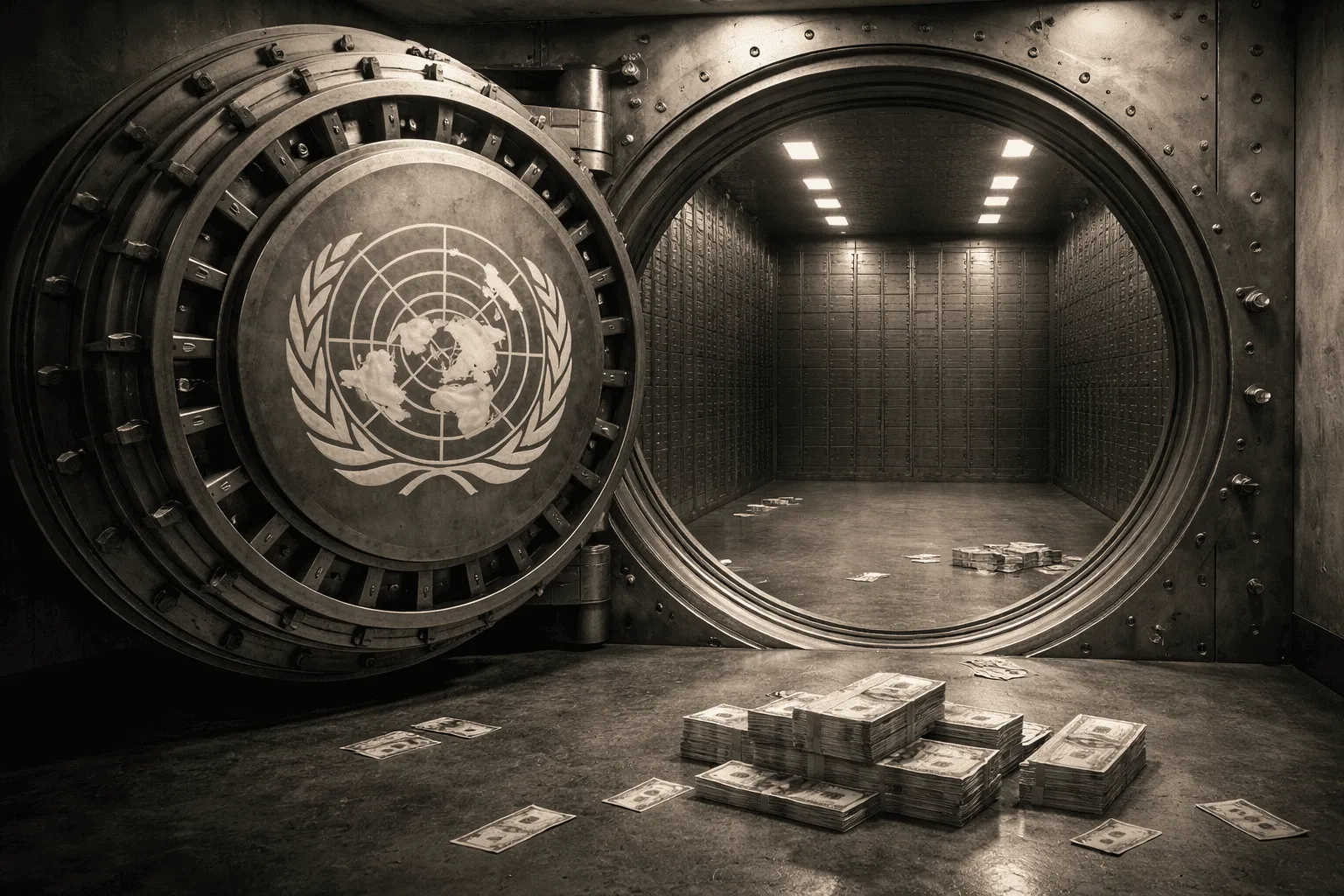
In January 2026, UN Secretary-General Guterres warned member states of the ‘imminent financial collapse’ of the United Nations. When rigid application of financial regulations threatens the UN’s ability to function, the Secretary-General’s responsibility as chief administrative officer does not end with warning member states. Constitutional practice and jurisprudence suggest a duty to act, temporarily and transparently, to prevent institutional failure while forcing political resolution.
A Liquidity Crisis that is also Constitutional
On 28 January 2026, the Secretary-General wrote to member states with an unusually blunt warning: the United Nations is running out of cash, and the situation could spiral into financial collapse. This was not about routine cash-flow management. It described a system caught in a downward spiral where late or missing payments force the Organization to slow spending, generate unused funds on paper, and then, by regulation, reduce its future income even further.
Public reporting of the letter leaves little doubt that the UN Secretariat does not view this as a technicality. The Secretary-General links the situation directly to the UN’s ability to pay staff, honor contracts, and keep core operations running. Two elements of the letter stand out. First, it makes explicit that applying the crediting regulation now carries real risks for default. That alone moves the issue beyond bookkeeping. Second, it makes clear that the problem is not excess money being returned, but money that was never there in the first place. So, the UN is being required to give financial effect to credits even though the cash behind them does not exist.
Cassandra or Chief Administrative Officer?
The Secretary-General’s letter places him uncomfortably close to the figure of Cassandra, who in Greek mythology was cursed by Apollo to accurately foreseeing disaster, warning repeatedly, yet remaining bound by choice or interpretation from intervening to prevent it. The letter diagnoses a clear causal chain leading toward insolvency, but presents his role as largely exhausted once that diagnosis has been communicated.
That posture may be procedurally orthodox, but it is constitutionally unsatisfying. The Charter does not cast the Secretary-General as a prophetic observer of institutional failure. It designates him as the Organization’s chief administrative officer, entrusted with responsibility for its functioning and continuity.
In his final year in office, the Secretary-General faces an unusually asymmetrical incentive structure. Reappointment is no longer a consideration, and the marginal political cost of necessity-based judgment is lower than it would be earlier in a tenure. What remains most salient is institutional legacy: whether the Organization was steered away from a self-inflicted collapse, or whether procedural caution prevailed while solvency failed.
Jurisprudence: The Charter Interpreted Functionally
This understanding of executive responsibility is reinforced by the International Court of Justice’s 1962 advisory opinion in Certain Expenses of the United Nations. Although the case concerned peacekeeping expenditures, the Court’s interpretive approach has broader relevance. It emphasized that when the Organization takes action appropriate to the fulfilment of its purposes, the presumption is that such action is not ultra vires, that is, beyond the UN’s legal power.
The Court did not grant carte blanche to the executive, and it reaffirmed the General Assembly’s control over the budget. But it also rejected rigid readings of the Charter that would render the Organization incapable of carrying out responsibilities entrusted to it. This functional method underpins a proposition that remains powerful in UN constitutional discourse: the Charter should not be interpreted in ways that make institutional survival impossible.
Practice: How the UN has actually Survived Past Crises
Historical practice points in the same direction. During past peacekeeping financing crises, liquidity shortfalls, and payroll emergencies, Secretaries-General have repeatedly acted at the edge of formal authority to keep the Organization functioning. These actions were controversial, flagged by auditors, and criticized by member states. Yet they were also routinely regularized after the fact, because the alternative, i.e. operational paralysis or collapse, was politically unacceptable.
Recent oversight work reinforces that this is not a theoretical dilemma. The Joint Inspection Unit’s 2024 system-wide review of budgeting notes that liquidity difficulties periodically occur and calls on legislative organs to find sustainable solutions. The same report documents that the treatment of surpluses and unspent balances varies across the UN system. Some entities surrender surpluses to Member States; others retain them to finance future budgets or capital investments. This diversity matters: it shows that “returning” funds is not an immutable financial law, but a governance choice.
Warning Without Intervention
Read carefully, the Secretary-General’s letter identifies a systemic contradiction: the Organization is being required to apply a crediting mechanism even when the underlying cash is absent. The problem, therefore, is not excess liquidity being returned, but insufficient liquidity being notionally offset.
The letter does not specify how “crediting back” is operationalized in the current cycle. Since the crisis is fundamentally a liquidity shortage caused by late or non-payment of assessments, then giving immediate financial effect to credits, especially if it reduces near-term assessed inflows, ceases to be a neutral accounting step. It becomes an executive decision point with constitutional consequences.
Acting Without Overreaching
The current liquidity crisis is often presented as a technical budgeting problem awaiting a political fix. In reality, it is a test of constitutional responsibility. The choice is not between legality and illegality, but between functional interpretation and procedural fatalism.
The Secretary-General cannot rewrite the Financial Regulations. But if the UN were to slide into insolvency because its chief administrative officer felt bound to apply a regulation whose destructive effects he had already identified, that outcome would not demonstrate fidelity to the Charter. Necessity-based deviation, framed as temporary, reversible, and reported immediately to the General Assembly, aligns with past practice and with the functional interpretation endorsed by the Court. It also respects the ultimate authority of member states by compelling them to decide, rather than allowing inertia to decide for them.
About the author
Patrick Tiefenbacher (MIA’98) is an international affairs practitioner and adviser focused on how multilateral institutions respond to stress, management failure, and reform. He has spent over 25 years working with UN and otherer multilateral organizations, and their governing bodies on financial governance, operating model redesign, and institutional resilience. He leads Global Goals Consulting in Vienna.
The views and opinions expressed in this think-piece are those of the author and do not necessarily reflect the official policy or position of SIPA or Columbia University.
Photo Credit: The image was made with ChatGPT