
Who Joins the Club? How Geopolitics Shapes Membership in International Organizations
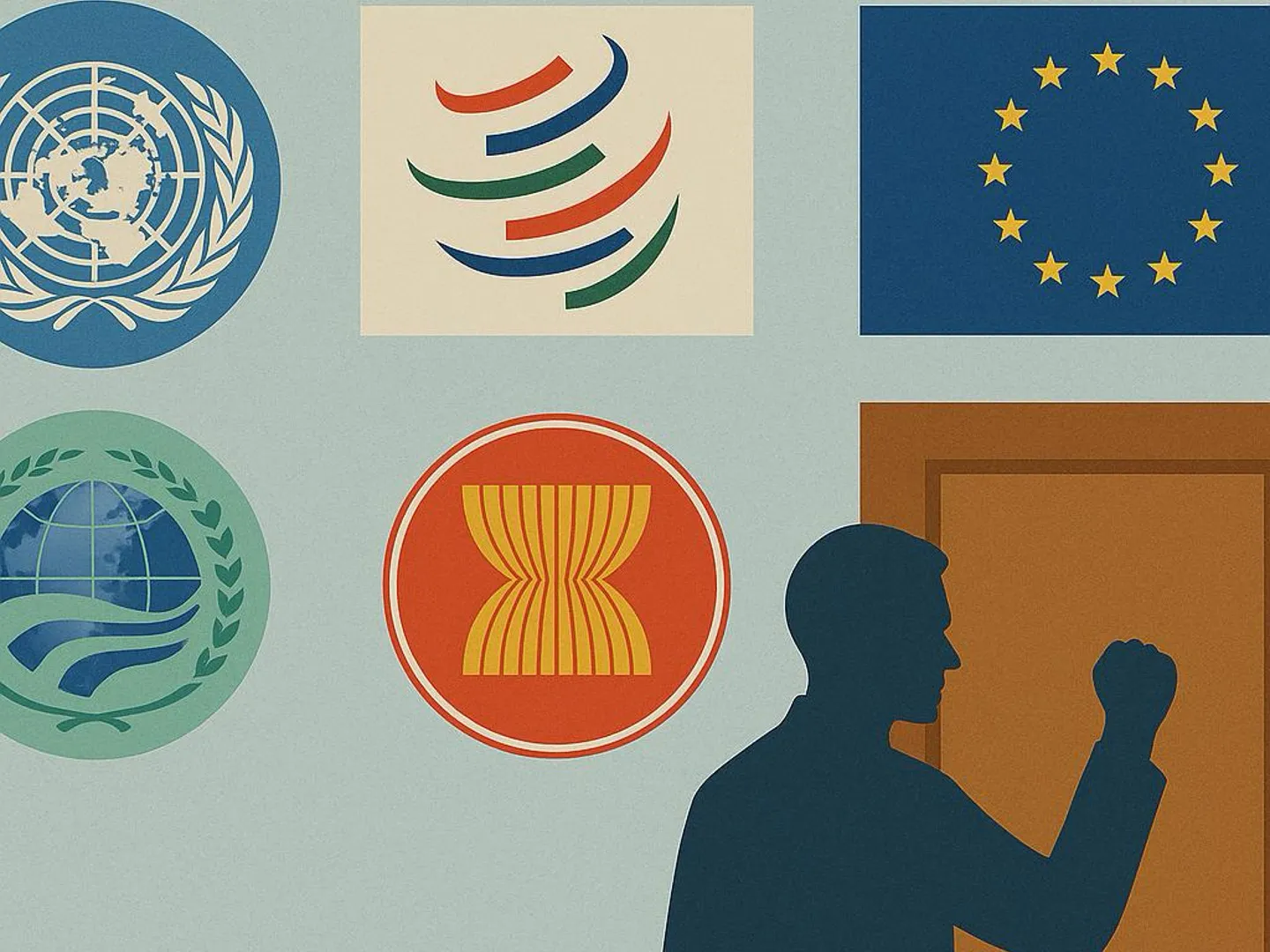
International organizations are not neutral venues for global cooperation. Rather, they operate as exclusive groups shaped by geopolitical interests. Membership is less a matter of meeting technical qualifications and more about strategic alignment with powerful states. This relational dynamic shapes decisions on entry, elevates some states while excluding others, and fundamentally determines the composition of the global governance architecture.
My book Discriminatory Clubs: The Geopolitics of International Organizations develops three key insights. First, states design international organizations with flexible accession rules, enabling them to exercise discretion when admitting new members. Second, geopolitical alignment—rather than economic policy performance or governance quality—serves as the main predictor of membership. Third, allies enjoy faster accession on easier terms, while rival or unaligned states encounter more conditions and delays. The biased entry process limits the inclusiveness of multilateralism and sets the stage for organizations to form rules that reinforce the interests of some states more than others.
Design for Discretion: How Rules Enable Bias
Accession rules in intergovernmental organizations (IGOs) are often deliberately vague, allowing existing members to exercise significant discretion in deciding who may join. Rather than relying on neutral, technical criteria, most IGOs give member states the authority to approve or block candidates. A typical mechanism is a membership vote—often requiring unanimity or a supermajority. Few organizations require standardized compliance reviews or enforce pre-established conditions. Even in legalistic IGOs like the the World Trade Organization (WTO) or regional organizations like the European Union or the Association of Southeast Asian Nations (ASEAN), accession negotiations can shift based on political and security ties with other states.
This institutional design serves strategic purposes. Founding states can join with other partners who share their security or ideological objectives while excluding competitors. Subsequent enlargement can reinforce this pattern through selectively admitting allies while delaying or rejecting others. The vague membership criteria also make it possible to impose differential costs that require rivals to make greater concessions as a condition of entry. By embedding discretion into the rules, international organizations become like social clubs shaped by the political preferences of their members.
Clubs of Allies: Geopolitical Alignment as the Magnet for Cooperation
Many criteria could serve as the focal point for cooperation. But the leaders and diplomats at the helm of negotiations over IGO membership have favored geopolitical alignment as the best way to select whom to trust as partners in multilateralism. Analysis of more than 200 multilateral economic organizations shows geopolitical alignment with other members of an IGO, whether measured by alliances or similar positions in UN voting, significantly increases the probability of membership alongside trade ties as part of a weighted decision process.
Even for the trade regime that declares all governments that control their trade policy to be eligible for membership, alliances matter. Japan and Korea were helped in as Cold War allies, while the USSR and China remained on the outside for over fifty years. Many now ask if it was a mistake to let China into the WTO in 2001, because of concerns about non-compliance with the trade rules and economic gains by a mercantilist rival. Economic statecraft is not a precise science. The effort to assess foreign policy trajectory is prone to misjudgments, and organizations that get bigger have more participants trying to bring in their friends and expand the club. Yet even if states come to regret their choice, research shows that exit and expulsion are rare.
Japan’s Membership Strategy
Japan offers an example of a country that has used entry into IOs to build legitimacy, signal alignment, and develop regional influence. Japan’s engagement with IOs dates to the late 19th century, when it joined the Universal Postal Union and the International Telegraph Union as part of a broader campaign to signal modernity and civilization to Western powers as it emerged from isolation. However, by the 1930s, as Japan adopted an increasingly militaristic posture, it withdrew from institutions like the League of Nations.
Following World War II, Japan’s reentry into international society was orchestrated through U.S.-sponsored accession to the Bretton Woods institutions, the General Agreement on Tariffs and Trade (GATT), and eventually the Organisation for Economic Co-operation and Development (OECD). These memberships not only enabled policy cooperation but also served to anchor Japan within a rules-based order firmly engaged in the U.S. alliance network. More recently, Japan’s leadership in forming the Comprehensive and Progressive Agreement for Trans-Pacific Partnership (CPTPP) reflects a deliberate strategy to shape the regional trade architecture in ways that balance China’s growing influence. At the same time, Japan along with the United States declined to join the China-led Asian Infrastructure Investment Bank (AIIB). The selective engagement strategy aligns with Japan’s security and diplomatic priorities.
Lessons for Practice and Policy
Diplomats and practitioners should recognize accession politics as taking place within international society, where technical reforms alone are often insufficient. Success to join requires coalition-building and allies. The result can be a more cohesive organization, but often we observe overexpansion by IOs. Admitting too many states for strategic reasons, erodes institutional effectiveness. The difficulty of expelling states means that changes in geopolitical interests could result in hostility among members that hinders reform. One also cannot expect substantial reform leverage when a major incentive for membership is status rather than policy transformation.
As scholars, we must no longer treat selection into organizations as either exogenous or derivative to issue-area interests. Instead, it is vital to examine how membership rules and processes themselves are politically constructed and strategically manipulated. Relationships among states are the starting point to cooperation, and shared IGO membership locks in their subsequent actions. Future work should study the networks of geopolitical influence to map the underlying structure of global governance.
The evolving geopolitical rivalry between the United States and China will continue to reshape multilateralism. China’s creation of the AIIB and leadership in BRICS exemplify a strategy of constructing parallel institutions that reflect an alternative vision of global order. In response, the Biden administration emphasized its alliances and working through Western-led IGOs. The Trump administration has backed away from multilateral organizations, leaving a leadership vacuum. If China takes the driver’s seat for future enlargement, it will favor entry by friends and set rules that advantage Chinese goals. With this new leverage over global governance, the rules-based order may take an illiberal direction. As tables turn, the United States may later find itself excluded from organizations that it no longer controls. Decisions about who joins are powerful tools of geopolitical contestation.
Conclusion: Multilateralism for Friends
The logic of IGOs acting as discriminatory clubs challenges the assumption that global cooperation flows directly from either common interests or liberal norms, showing instead how geopolitical favoritism structures access to cooperation. Relations among states bring friends together in IGOs where they set the rules of the game that go forward under principles of multilateralism.
This insight complicates the optimism surrounding global governance. If international organizations begin as clubs built on selective friendship, their capacity to serve as universal problem-solvers will be limited. Membership matters, and it is never neutral. Who gets in—and when—is shaped more by politics than performance. As the world moves into a new era of multipolarity, the stakes surrounding membership and exclusion will only intensify.
About the author:
Christina Davis is the Edwin O. Reischauer professor of Japanese Politics at Harvard University. She is a scholar of international organizations and foreign policy. Her earlier books focus on international trade, and she is currently writing about how economic security impacts the evolution of the trade regime.
This think piece is based on the author’s book, Discriminatory Clubs: The Geopolitics of International Organizations (Princeton University Press, 2023).
The views and opinions expressed in this think-piece are those of the authors and do not necessarily reflect the official policy or position of SIPA or Columbia University.
Photo credit: The image was created by ChatGPT.