
In January 2026, UN Secretary-General António Guterres warned, “the UN is facing an Imminent Financial Collapse”, highlighting the most severe crisis faced by the UN in its eight-decade history. Against a 2025 regular budget of approximately $3.7 billion, unpaid dues surged to a record $1.6 billion, which was more than double the arrears recorded at the end of 2024. At the heart of this fiscal stress lies a structural vulnerability, which is the UN’s dependence on member state contributions, particularly from major donors such as the United States. Delayed or withheld payments have exposed the fragility of this funding model, raising a fundamental question of whether an institution of such global significance can be allowed to operate on such financial uncertainty? Beyond the regular budget the revenue of the entire UN system was $ 67.6 billion in 2023, of which 70% was voluntary funding and 61% earmarked for specific projects or areas of work.
The UN is one of the most consequential and impactful creations of the twentieth century. It was created when the world was devastated by two world wars and nuclear attacks, which took millions of lives. Non-occurrence of World War III, and no nuclear attacks in eight decades, is no small achievement of the UN. Beyond peacekeeping, its agencies are deeply embedded in human welfare at the global level by addressing poverty, advancing gender equity, combating climate change, and safeguarding human rights. Such a critical institution cannot be allowed to perish, or even shrink for want of funds. At such a juncture, the UN should issue its own currency, which would generate sizable direct revenue and thus be an important step toward increasing the world organization’s financial autonomy.
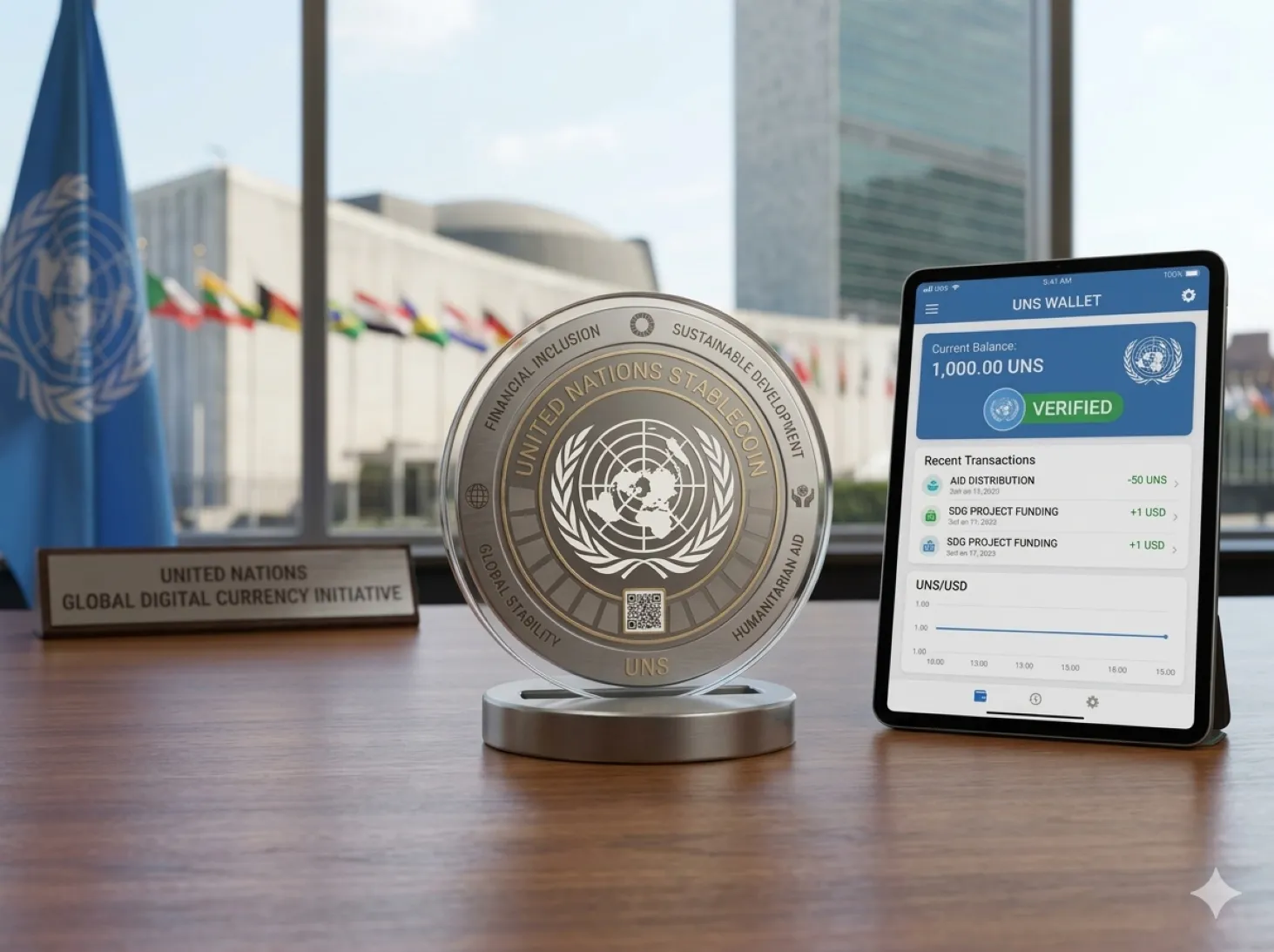
The UN must create a UN STAbleCoin (UNSTAC) currency
The UN General Assembly should authorize the creation and issuance of the UN currency. This would be an international currency in the form of Stablecoins, christened as UNSTAC (UN STAbleCoin). For the issue and management of this currency, the UN may create a new agency called UN Monetary Authority (UNMA), potentially headquartered at a neutral location like Geneva, Switzerland.
The architecture of UNSTAC would be grounded in three principles:
- Stability: UNSTAC would be pegged to a weighted basket of five major global currencies, namely US Dollar, Euro, Chinese Renminbi, Japanese Yen, and the British Pound, which would ensure low volatility.
- Credibility: The UNSTAC would be issued on a permissioned, institutional-grade blockchain, and backed 1:1 by high-quality reserve assets (such as sovereign bonds and cash equivalents), held in a bankruptcy-protected structure administered by UNMA.
- Governance: Operated under a multilateral charter to insulate it from unilateral geopolitical influence.
A currency must perform three essential functions: medium of exchange, store of value, and a unit of account. UNSTAC is designed to fulfil all three simultaneously, and would have the following potential applications:
- Cross-border payments: Enabling faster and lower-cost international transactions compared to legacy systems.
- Reserve asset: Inclusion in foreign exchange reserves by the central banks and monetary authorities.
- Multilateral settlements: Streamlining financial obligations between countries and international institutions. UNSTAC would be redeemable at par by the holders.
A UN Currency would generate direct revenue for the UN and stabilize the global monetary system
The fiscal benefit to the UN from UNSTAC issuance would derive from three principal streams:
(i) Seigniorage revenue from token issuance, representing the difference between the face value of UNSTAC issued and the cost of maintaining the reserve pool;
(ii) Reserve investment income generated by the collateral pool invested in short-duration government securities, such as US T-bills etc; and
(iii) Transaction fee revenue from UNSTAC-denominated transfers processed through the UNMA infrastructure.
Based on conservative projections, drawn from stablecoin industry growth patterns and UN transaction volumes, the UNSTAC circulation could reach $80–90 billion within five years. This could generate substantial revenue of approximately $5 billion annually. Such a shift would fundamentally alter the organization’s financial architecture by enabling it to rebuild liquidity buffers, strengthen peacekeeping reserves, and sustain core operations without relying solely on member contributions.
This concept of international currency is not without precedent. The International Monetary Fund’s Special Drawing Rights (SDR), introduced in 1969, already represent a basket-based international reserve asset. UNSTAC would extend this logic, by creating a digital currency with enhanced usability and scalability.
Stablecoin Market and Legal Framework
The global stablecoin market registered an over 50% increase since early 2025 and reached a capitalization of $317 billion by April 2026. This is further projected to grow between $1.9- $4 trillion by 2030. Furthermore, the annual transaction volume of stablecoins exceeded $27 trillion in 2024, which is more than VISA and Mastercard combined. The passage of the US GENIUS (Guiding and Establishing National Innovation for US Stablecoins) Act in July 2025, and the full operationalization of the EU's MiCA (Markets in Crypto Assets) framework in December 2024, provide legal precedents around which a UNSTAC can be operationalised.
The introduction of a UNSTAC carries significant implications in terms of institutional independence of UN, by enhancing global trust,as the UN-issued currency could become a stabilizing force in an increasingly fragmented monetary system,and positioning UN as a leader in global finance. UNSTAC would have to compete in an already competitive stablecoin market, but is expected to achieve fast adoption by individuals, institutions, and central banks, due to the trust generated by the UN backing and its essentially multinational character.
An UN-issued stablecoin would not be a radical departure, but a logical evolution. In a world increasingly defined by digital finance and geopolitical fragmentation, the UN has an opportunity to redefine its role not just as a convening authority but as a foundational pillar of global economic infrastructure. It must be one of the core reforms at the UN under the new Secretary-General.
About the Author:
Dr. Ashutosh Upadhyay, is currently a scholar at the SIPA, Columbia University, pursuing an MPA in Global Leadership. He works as a General Manager at the Reserve Bank of India and has over 20 years of experience in the areas of digital payment systems, currency management, crypto currency, and banking supervision.
The views and opinions expressed in this think-piece are those of the author and do not necessarily reflect the official policy or position of SIPA or Columbia University.
Photo credit: The image was made with Google Gemini