
Rebalancing Security - From Rising Military Spending to Investing in Diplomacy and Development
Eighty years after the foundation of the United Nations, the prospects for Article 26 of its Charter –calling upon Member States to maintain peace and security with the least diversion for armaments of the world’s human and economic resources– have never been bleaker. In fact, the opposite is occurring. With military expenditure reaching an unprecedented $2.7 trillion in 2024, a higher proportion of resources has never been diverted to armaments. A spiraling trend that is likely to continue.
The dilemma facing the world is whether to surrender to the seeming inevitability and magnetism of militarization or to challenge it, reshape it and forge a new path that addresses threats to humanity, threats that include but extend beyond the military domain.
Drawing on the UN Secretary-General’s report The Security We Need: Rebalancing Military Spending for a Sustainable and Peaceful Future, this think-piece argues that rather than focusing on ‘the fear of whom’ - other states or people-, we should refocus on ‘the fear of what’: planetary threats, underdevelopment, structural imbalance in the global system of production and exchange. The path forward lies in addressing these shared challenges and fostering a culture of peace anchored in common humanity and predicated on trust, solidarity, and universality.
It’s important to understand the limits of militarized approaches to creating lasting peace and security. Prioritizing military expenditures over long‑term investments in sustainable development may address the immediate manifestations of conflict, but it does little to tackle the underlying structural drivers of instability. Diplomacy, conflict prevention, transparency and cooperation are cornerstones of advancing peace and security.
The Secretary-General’s call to forge a new global compact
The Secretary-General’s report The Security We Need, mandated by UN Member States through the 2024 Pact for the Future, is an urgent call to rebalance our responses to military threats and other global challenges.
It outlines five key recommendations:
1. Reviving diplomacy and peaceful dispute resolution
2. Strengthening the disarmament agenda and linking it to the post-2030 development framework
3. Promoting transparency and confidence-building
4. Increasing investment in development financing
5. Reframing security through a human-centered lens.
Some of the recommendations are long‑standing—perhaps even aspirational—such as the call to reinvigorate diplomacy. Others are systemic, requiring a fundamental rethinking of global security, such as the praxis of disarmament and development linkages. Others can be addressed immediately and in several contexts.
The implementation of these recommendations needs to be adapted to specific contexts and requires bold multilateral leadership and partnerships. Yet their impact will depend on who is listening and how states choose to respond to this clarion call.
People, States, and Fear
The unprecedented surge in global military expenditure is not merely a statistic but a reflection of a world in transition. Today’s world is marked by rising geo-strategic tensions and profound historic deficits in trust and solidarity.
The staggering level of military spending reflects a deeper anxiety within human coexistence. We live on the same planet, but often in different and increasingly mutually exclusive worlds. As the notion of a common humanity becomes increasingly threatened and replaced by a creeping hierarchy of humanities, the tendency is a nativistic conception of security that is translated into seeking the means of war. As a result, we focus more on who appears to threaten us rather than what threatens us.
Militarized approaches alone are insufficient to achieve security
The anxieties driving military expenditure are real and rooted in threats to sovereignty, territorial disputes, and power dynamics. Each region and country faces distinct challenges, and respectively a unique consternation of insecurity. In some contexts, increased military spending supports the foundation for stability and development, especially in fragile or conflict-affected areas.
However, lasting security cannot be achieved through military spending alone. Over time, the economic, social and political costs may outweigh the ‘benefits’ of ever-increasing military spending. Increased military budgets can strain national economies and deepen debt, leaving future generations with little fiscal room to navigate. They divert resources from essential national and global development and societal priorities, including health care, education and innovation.
Rising military spending can trigger arms races, eroding trust and escalating tensions. Instead of fostering security, militarization may ultimately heighten insecurity. What we pursue to feel safe may not make us entirely safe and can, in fact, produce the contrary effect.
The military response to insecurity, reflected in spiraling defense budgets, often prioritizes territorial sovereignty and the physical elimination of those perceived as ‘others’. While such approach may address certain dimensions of insecurity – it tends to overlook shared planetary threats and those that in the immediate sense affect ‘others’ but ultimately affect ‘us’ all. These challenges transcend borders and cannot be solved with weapons. They demand cooperation and solidarity, not confrontation.
The seeming inevitable militarism is ultimately neither impactful in achieving comprehensive, sustainable security. Rather, a human-centered, multidimensional approach to security represents the most viable option for addressing the complex interconnectivity of systemic threats facing humanity. Human-centered security does not exclude military security; rather it incorporates it within a broader culture of peace.
Trading development for weapons?
2025 marked the 10th anniversary of the Sustainable Development Goals. Regrettably, the historical upswing in military expenditures stand in sharp contrast to the steep decline in resources allocated for achieving the SDGs.
The 9.4% increase in global military expenditure in 2024 stands in stark contrast to a 9% decline in Official Development Assistance (ODA). Militarization is prioritized over development. These two seemingly mutually exclusive trends must be reconciled through a human-centered conceptualization of security.
While the inverse relationship between military expenditure and SDGs is not new, it is at an unprecedented and alarming level.
Progress toward attaining the SDGs is faltering, deepening inequality and sowing the seeds of future conflict. This shortfall reflects a deep fracture in our commitment to “leave no one behind”. How then do we address this systemic imbalance?
Promoting efficiency, transparency and accountability in military expenditure at the national level
While multilateral action is essential, meaningful progress often begins at national and local levels. No member state needs to wait for another to act. States can begin by creating National Action Plans to implement the Secretary-General’s recommendations.
Transparency in military expenditure is a low-hanging fruit with high impact to center in this effort. It fosters trust and confidence between countries and supports regional confidence-building measures to reduce tensions and miscalculations. Transparency does not imply vulnerability. It is a tool for trust and confidence-building, not a threat to sovereignty.
Countries should adopt public expenditure and financial accountability standards in the defense sector, such as external and internal audits and parliamentary oversight and civil society engagement. These mechanisms empower citizens to scrutinize how public funds are used, fostering a culture of transparency and shared responsibility. Defense budgeting is often shrouded in secrecy, leading to opacity. It is therefore important to distinguish confidentiality from secrecy. The two should not be conflated.
Security is not the sole domain of governments. It is a societal endeavor. When people are involved in decisions about security spending, everyone becomes a champion for peace.
Way Forward: Various ways to the same destination?
States are not merely adversaries to be contained, exploited, or overpowered. They also share common threats against which they need to collaborate, such as poverty, hunger, lack of education, and the climate crisis that harm the most vulnerable and divide humanity. The search for common ground is the search for security. What is needed is a culture of peace.
Rebuilding trust is the first step toward rebuilding our shared humanity. Security must be recalibrated to safeguard people and communities, not only focus on protecting borders and territories. Only by embracing a human-centered and multidimensional view of security can the international community effectively respond to interconnected challenges. With only five years left to achieve the SDGs, the stakes are high, and the timeline is short.
In any event, ambition should not deter action. Even the most complex challenges begin with simple steps. Let us start by rebuilding trust in governments, in our institutions, and in each other. Let us shift from fear-based budgets to trust-based cooperation. Let us return not only to living on the same planet, but to living in the same world. A world where we are not victims of our own anxiety but champions of each other and our common humanity.
About the author
Dr. Adedeji (Ade) Ebo is Director and Deputy to the Under-Secretary-General and High Representative for Disarmament Affairs at the UN Office for Disarmament Affairs (ODA) and Visiting Professor at the School of Global Affairs, Kings College, University London. Previously, Dr. Ebo has held various leadership positions across the UN system, including as Chief of ODA’s Conventional Arms Branch and Chief of Security Sector Reform in the Office for the Rule of Law and Security Institutions, Department of Peace Operations. He also served as Director of Political Affairs of the UN Office for West Africa and Sahel and the UN Operation in Côte d’Ivoire.
The views and opinions expressed in this think-piece are those of the author and do not necessarily reflect the official policy or position of SIPA or Columbia University.
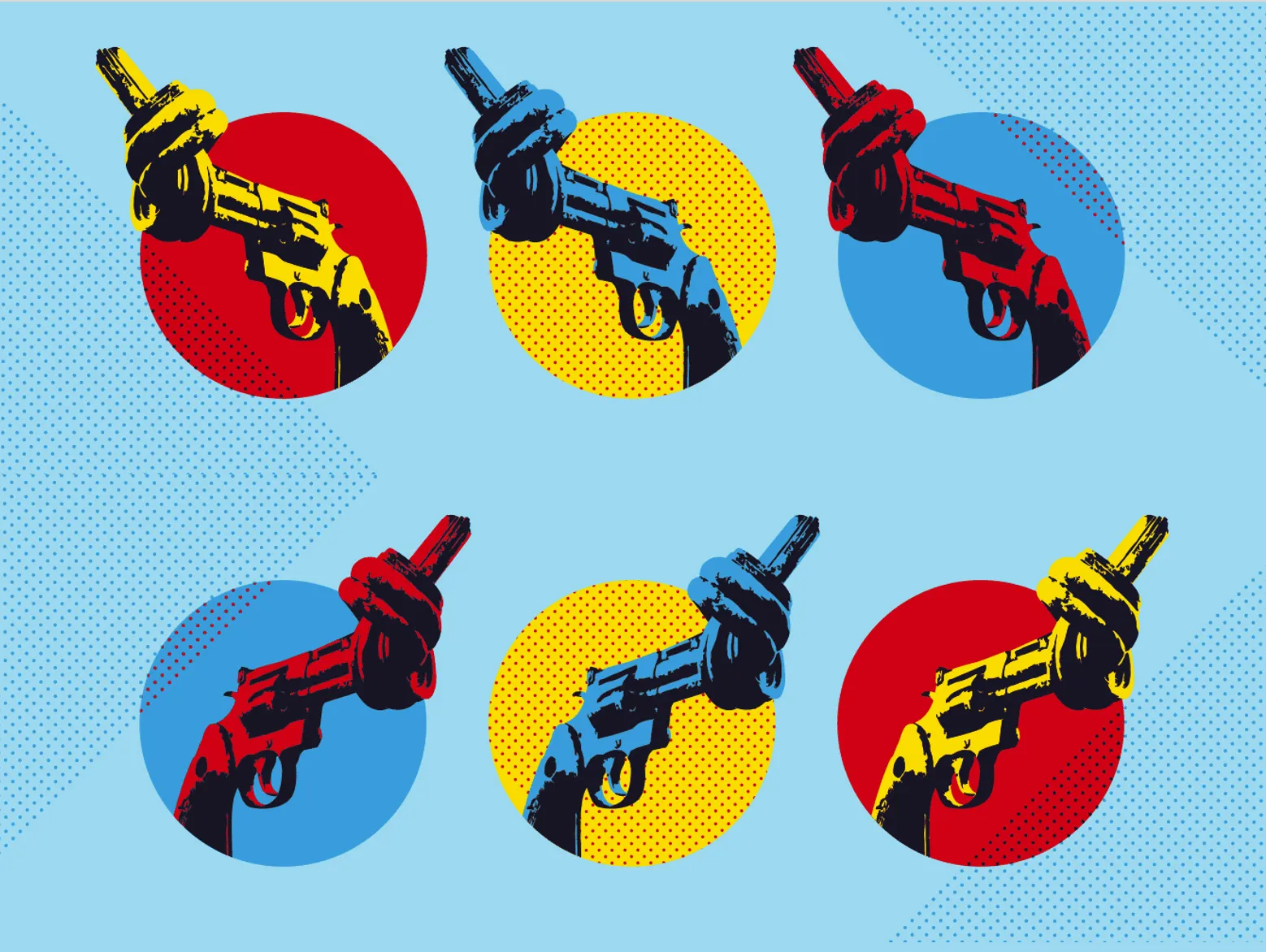
The image is from SG report’s Trello board