
Mediators at the Helm: How the UN Failed Syria and Why Accountability Is Key to Saving International Peace-making
Since the onset of violence in 2011, Syria has come to embody more than just the tragedy of more than a decade of conflict and unchecked mass atrocities. It is a mirror that reflects the dangerous unraveling of the international peacemaking system and hollowing out of the UN’s raison d’être as its custodian. It is a reflection, champions of the UN cannot afford to overlook, if they are to salvage the organization’s relevance at a time defined by conflict and skepticism. My book, UN Mediators in Syria: The Challenges and Responsibilities of Conflict Resolution (Cambridge University Press, 2024) is not a eulogy for the United Nations. Nor is it an elegy for Syria, though it chronicles the ill-fated efforts to resolve its conflict. It is, rather, a reckoning with the state of international conflict resolution, and with a seemingly mythical figure at its helm that is often both venerated and scapegoated, but rarely ever truly understood: the mediator. It begins by prying open the black box of mediation, documenting what each UN mediator in Syria actually did in their role. It then probes further, examining the strategic perspectives that guided each mediator’s hand: how they saw themselves, the parties involved, the context they operated in, and the very process of mediation. Beyond Syria, it introduces a novel method to precisely trace the actual input of mediators on the peace processes they oversee and maps the strategic foundations of their decision-making.
We must learn from past UN mediators about the complex system in which they operate
What do UN mediators actually do? The UN’s mediation efforts in Syria, that have been ongoing since 2012, and seen four different envoys take on the mantle, offer a vital lesson in that regard: UN mediators must not be treated as unitary rational actors but as individuals with agency, impact, and responsibility.
Often a confusingly multifaceted organization, the UN is comprised of member states, compartmentalized in different organs with distinct responsibilities and powers, administered by a bureaucratic international civil service, and headed by a Secretary-General. But when it mediates in conflict, its face is singular. It is former UN Secretary-General Kofi Annan, who in 2012 as joint special envoy of the UN and the League of Arab States first framed the violence in Syria as a civil war as opposed to one of authoritarian repression at a time when naming the violence was hotly contested in the UN, in Syria, and global capitals. For most of his mediation, Annan sought to incentivize Syria’s then-president Assad to engage with political negotiations by avoiding to decisively tackle the fate of Assad in a political solution. Taking a different turn, his successor, Lakhdar Brahimi repeatedly stressed that Assad could not be “king” but “kingmaker.” And while toward the end of his mediation Brahimi would warn that local ceasefires distanced from the main track of political negotiations were part of the Assad regime’s war solution, his successor, Staffan de Mistura would kickstart his mediation by advancing a ‘freeze’ in Aleppo—one that would later end with the capitulation of the city to the Assad regime.
Each UN envoy for Syria came from a distinct background. Kofi Annan, the former Secretary-General, stood as a global statesman. The second envoy, Lakhdar Brahimi was a longstanding troubleshooter of the UN sent to resolve some if its toughest conflicts. He came from a quieter world of crisis negotiation that often requires its players keep their cards close to their chest. Lacking the career pedigree of his predecessors, the third envoy, Staffan de Mistura, had a humanitarian background with an eye for the spotlight. Not only did the mediators vary in their backgrounds and strategic approaches to the job, accentuating the significance of examining their individual input on the mediation process, they also had significant margins of maneuver, each largely able to drive the peacemaking efforts of the UN during their tenure.
UN mediators and the decisions they make matter
Each made decisions whose implications resonated beyond the negotiating table. UN mediators do not marshal armies or author the wars they are tasked with resolving. But by framing the terms and process of negotiation, legitimizing or sidelining key stakeholders, and shaping global and local narratives, mediators become embedded in the equation of war and peace—instruments of diplomacy that can either accelerate or stifle the path to peace. Their decisions on timing, process, methods, concessions, and even when and how to exit, can either foster political momentum or entrench the status quo. And yet, none were elected by civilians across Syria who lived with the implications—intended or otherwise—of such decisions—the very people Brahimi dubbed “our first masters.”
The UN’s failure to mediate a just peace in Syria runs the risk of making it a dispensable organization
In the end, the failure to mediate a just peace in Syria may be remembered as the moment the UN missed its last, best chance to restore meaning to its founding promise and assert its purpose in a world at war. In response to one of the worst humanitarian catastrophes of the 21st Century that demanded decisive action and moral resolve, the UN repeatedly offered procedure without progress—catalyzing its decay into an increasingly dispensable organization. Mediators certainly do not operate in a vacuum; but they also do not disappear into one. While my book critically engages with the broader environmental and institutional dynamics that impacted the peacemaking process, such as divisions in the Security Council, the metastasizing of the conflict, and impact of external conflicts, it zooms in on the human decision-makers operating in between.
We must examine the specific decision-making of UN mediators
Mediators must be treated as the actors they are—individuals with agency that oversee processes that have a tremendous impact on those made vulnerable by the horrors of war. The goal here is not to single handedly blame mediators—as mediators often complain their critics do—for the UN’s failure to resolve the conflict in Syria. But rather it is to demand answers as to what happened during more than a decade of peace-making. What did each mediator do in their role and why? What strategies were pursued? What initiatives were forgone? What moments were seized, and others lost? To answer these questions it’s paramount to examine the decision-making of these mediators and the leeway they had to pursue their objectives.
In one of my interviews, a former UN envoy explained that he regularly pressed the parties to the conflict that were adamant on a full victory to consider what would happen the day after. For him, the UN was the only actor able to midwife a credible roadmap for the future in any scenario where the guns would eventually go silent. That moment, seemingly unthinkable years ago when we spoke, is now real: Assad has exited Syria. To great consequence to the UN’s legitimacy in Syria, neither political milestones like Assad’s exit nor humanitarian imperatives like the freeing of detainees across prisons across the country have resulted through UN mediation efforts. But now that that moment has come to pass, there is perhaps no more damning indictment of each envoy’s individual and the organization’s collective failure than the realization that the UN is not meaningfully part of shaping the day after.
Accountability is the key to saving international peace-making
The reality is that the conversation about Syria’s future is happening without the UN. If policymakers in the UN seek to understand why the UN does not play an important role today, they must avoid the self-defeating path of self-defense or limit their reflection to the well-known structural factors in the Security Council that affect their international conflict resolution capacities. Instead, to truly explain to the Syrian people why years of UN peace-making efforts failed to bear fruit, one must look to the mediators that drove their organization’s peace-making efforts, examine their decisions, and unpack the strategic drivers behind their decision-making. As U.S. mediator Chester Crocker once wrote, if mediation is “a job worth doing…it is worth doing well. That means that someone must be placed in charge, held accountable, given the requisite mandate and resources, and steadily supported, or else replaced.” In my book, I offer the evidence and tools to do just that.
Far from being passive actors constrained by structural or contextual limits, Kofi Annan, Lakhdar Brahimi, and Staffan de Mistura exercised significant agency in conceiving, negotiating, and executing the peace-making policies that carried the UN’s name. Kofi Annan’s early framing of the Syrian conflict as a civil war, rather than an episode of authoritarian violence, shaped both the logic and limits of his mediation. Major initiatives, like his Six Point Plan, that sought quick consensus at the expense of addressing the core question of Assad’s future were not dictated by the Security Council; they were borne of Annan’s own strategic calculation about what he thought could rally consensus in the Council and incentivize Assad to cooperate. Taking a different approach, Lakhdar Brahimi’s decision to directly tackle that fundamental question early on and propose that Assad could be “kingmaker but not king” shattered any assumption that mediators are socialized to behave similarly and made clear they are distinct in how they interpret their roles and the context they operate in. Further demonstrating that agency, de Mistura’s controversial decision to begin his mediation by postponing negotiations on the political process and championing local ceasefires instead, rebrand them as “freezes,” and pilot them in Aleppo, marked a momentous shift from his predecessors and reflected his own strategic calculus, not the realities on the ground or deliberations of the Council. Every one of these decisions and the many others that defined each mediator’s tenure, from how to engage the parties to the conflict, to when to convene a peace conference, to how to manage spoilers and navigate pressures within the UN and on the ground, and even when and how to step down, mattered.
Above all, as I show in my book, we must ask something deceptively simple of the practice and study of mediation: that we tell the truth, and that we hold those who take on the momentous responsibility to broker peace accountable for nothing more or less than the decisions they make or choose not to. For this reason, we must establish accountability in mediation and reform the UN’s peace-making apparatus. As Ambassador Frederic Hof, the former U.S. Special Envoy for Syria, writes in his forward to the book, senior bureaucrats in the UN system should introduce elements of oversight, guidance, and accountability into the work of UN mediators. “To the extent, therefore, that the UN Secretariat and member states will continue to see value in naming Special Envoys to mediate between disputatious parties, Syria is worth careful study, because the Security Council dysfunction that plagued the mediators in Syria may be the wave of whatever future remains to the UN.”
About the author
Fadi Nicholas Nassar is a Senior Fellow at the Middle East Institute and Director of the Institute for Social Justice and Conflict Resolution at the Lebanese American University (LAU), where he also serves as Assistant Professor of Political Science and International Affairs. He holds a PhD from the War Studies Department at King’s College London and is a graduate of Georgetown University’s School of Foreign Service and Columbia University’s School of International and Public Affairs.
This think-piece is based on the author’s recent book UN Mediators in Syria: The Challenges and Responsibilities of Conflict Resolution (Cambridge University Press, 2024).
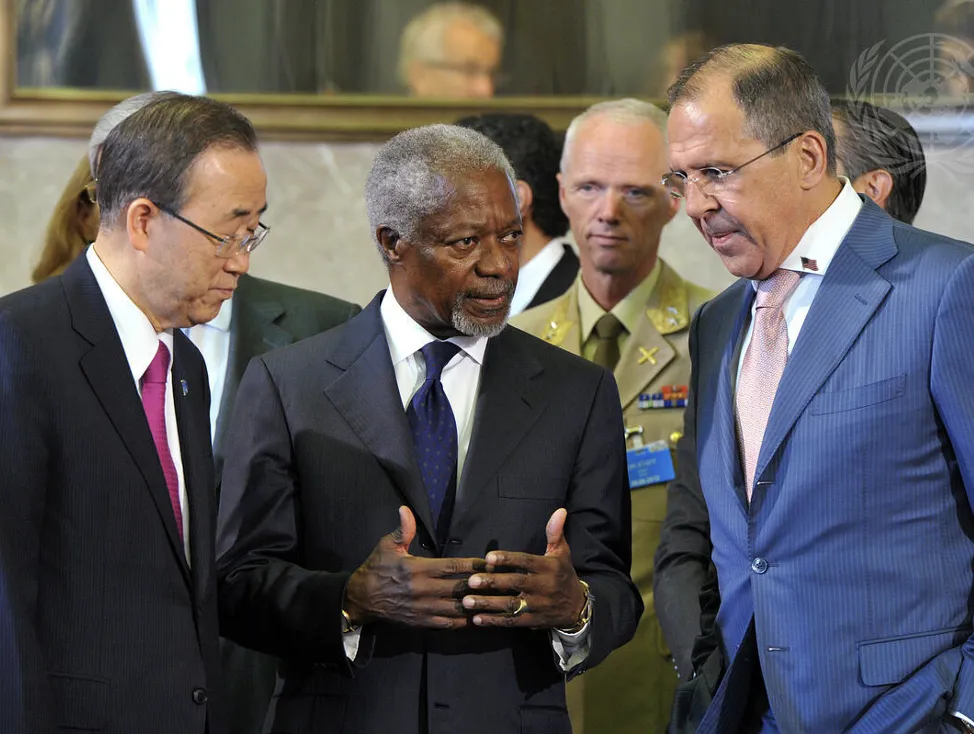
Photo Credit: UN Photo/Violaine Martin
At its first meeting in Geneva in June 2012, the UN-backed Action Group for Syria agreed on steps for a peaceful transition in the country. Kofi Annan (centre), Joint Special Envoy of the United Nations and the League of Arab States for Syria, converses with Secretary-General Ban Ki-moon (left) and Sergey V. Lavrov, Minister for foreign Affairs of the Russian Federation (right), at the meeting. Behind Mr. Annan is Major General Robert Mood, UN Chief Military Observer and Head of the UN Supervision Mission in Syria
The views and opinions expressed in this think-piece are those of the authors and do not necessarily reflect the official policy or position of SIPA or Columbia University.