
Mayors at the Table: Why the Multilateral System Needs Cities to Deliver Its Promises
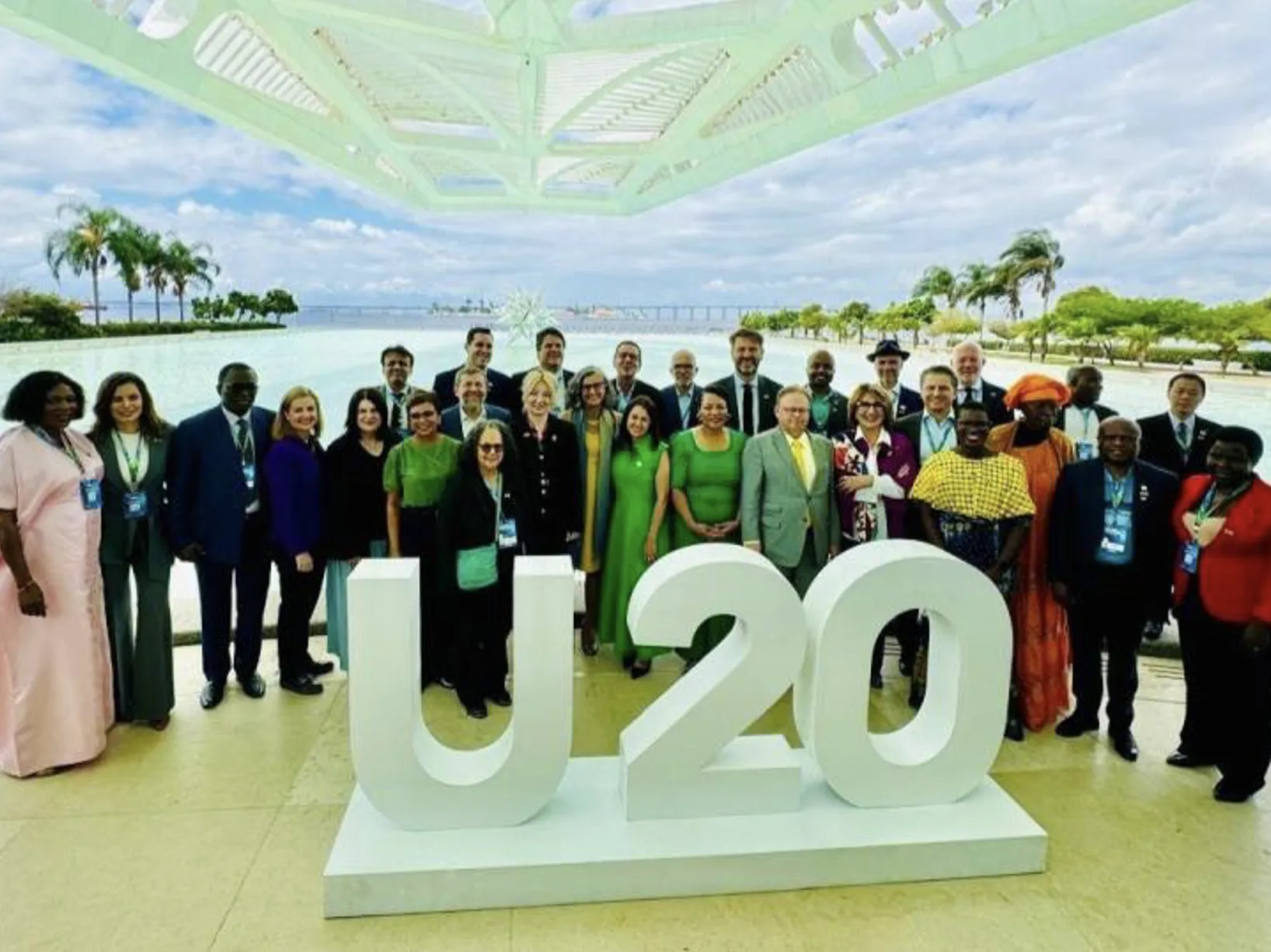
Global agreements on climate, migration, and humanitarian crises are negotiated by states but mostly delivered by cities. Cities are reactive, pragmatic and close to residents. Across 30 OECD countries, 45 percent of people trust their local government, against 39 percent for their national government.
Over the past two decades, cities have taken on international roles, often filling gaps where national governments and international organizations are constrained: community-level humanitarian support in Ukraine, norm-setting in the UN migration compact and multilevel climate governance.
Yet, cities have no formal standing in high-level negotiations. This is the moment to change that: a new UN Secretary-General takes office in January 2027, as the UN80 reform reshapes a leaner, cash-strapped system that will rely more than ever on those who deliver on the ground. The multilateral system should give cities a formal voice as governments and direct access to finance, while protecting mayors under threat.
Global deals succeed or fail in cities
Cities are governments with legal duties and, in most cases, elected leaders, housing over half of humanity and most of the world’s refugees. They also produce about 70 percent of energy-related carbon emissions. This is where global deals on climate and migration succeed or fail: what states commit to, cities must deliver.
Through networks such as the C40 Cities Climate Leadership Group and the Mayors Migration Council (MMC), mayors share solutions, raise funds and speak with one voice. We looked at three cases in which cities stepped in, and where it hit its limits.
Cities step in to meet community needs in wartime
Russia’s 2022 full-scale invasion of Ukraine accelerated city diplomacy. About two-thirds of larger Ukrainian cities have since formed new partnerships abroad.
These partnerships surfaced “micro” needs that states and aid agencies are ill-equipped to meet. Pre-war decentralization reforms had given local governments the money and authority to keep services running, even when occupation forced some to operate remotely from safer cities. Europe Prykhystok asked Ukrainian community leaders what an NGO connecting cities could do. A recurring response was time away from the war for its children; one in five Ukrainian children has lost a close relative or friend. Europe Prykhystok links Ukrainian towns with host towns in France, Germany, and most recently Sweden for two- to three-week respite stays alongside local peers. Over 2,000 children, many from frontline regions, are benefiting from this growing solidarity network of over 100 local authorities. Towns act within weeks with whatever resources they can muster, offering town-to-town support that complements large agencies focused on life-saving aid at scale. Yet the localities doing this work have little say in the forums where humanitarian and recovery priorities are set.
Mayors helped set a norm in the UN migration compact
In 2018, UN member states adopted the Global Compact for Safe, Orderly and Regular Migration. When the United States pulled out of the negotiations, around forty American cities stepped in with joint proposals so their residents would still be represented.
Several governments insisted that migrants’ access to health care and schooling be dependent on immigration status. Mayors pushed back. Cities do not decide who enters a country, but they must govern everyone who lives there. This was not a call for open borders but a view from the ground that rights-based governance is good governance: a city works only when every child is in school and everyone has access to medical attention. The final text calls for “non-discriminatory access” to health care and education. COVID-19 later proved the point: vaccination that excluded people by immigration status could not have contained the virus.
These historic negotiations also left lasting structures. The MMC was formed to keep city voices in UN debates, and its Global Cities Fund now directs money directly to city governments. The UN Secretary-General has called local governments “allies to promote and implement the Compact.” More than 50 new local pledges were announced at the second review forum in May 2026.
Cities pushed climate migration onto the UN climate agenda
Cities are not parties to the 2015 Paris Agreement, yet they implement it and push for more action: in 2024, about three-quarters of C40 cities were cutting per-capita emissions faster than their countries.
Climate and migration have long been handled in separate policy arenas; cities are helping connect them. According to the World Bank, climate change could force up to 216 million people to move domestically by 2050. Mayors present migration as a way to adapt, and launched a joint action agenda at the 2021 UN climate summit in Glasgow. In 2022, governments meeting in Egypt recognized climate-driven displacement in decisions on loss and damage. In Nice in 2025, some 200 coastal cities formed an UN-backed coalition to prepare for rising seas. Money remains the bottleneck. In 2025, cities sought a record 105 billion US dollars for climate projects.
City influence still depends on goodwill
Cities depend on national laws and budgets. Official development assistance fell by almost a quarter in 2025, and the UN humanitarian appeal for Ukraine was only about half funded, down from 70 percent in 2024.
Influence is also unequal. Large, wealthy cities engage globally far more easily than small cities in poorer countries. Some mayors campaign against inclusive policies. Without careful design, greater city power could deepen these gaps.
Three reforms would fuel cities’ impactful role in multilateralism
A leaner UN, as envisaged in the UN80 reform, should bring cities in as governing partners, not as one more stakeholder group. To get there, three changes are needed:
1. Formal standing. The UN should give cities formal standing in climate, development, and migration negotiations, since cities already deliver on related agreements. 80 countries have joined the CHAMP coalition to involve local governments in their climate plans. This presence must now be institutionalized. Formal standing would recognize them as governments, for example through an annual hearing of mayors at the UN General Assembly, like the one held for parliamentarians, as proposed by the Secretary-General last year.
2. Direct access to finance. National governments should let cities raise more of their own revenue and borrow responsibly. Multilateral development banks should lend directly to more cities; this would be game-changing in low-income countries. The model exists: the European Investment Bank lends directly to municipalities and the European Bank for Reconstruction and Development finances cities and their utilities, sometimes without a sovereign guarantee, as in Ukraine.
3. Protection for mayors. Mayors increasingly face intimidation, violence and harassment. Networks such as the Pact of Free Citieshelp mayors share strategies and make them harder to silence. Stronger legal safeguards and a democracy fund for cities, as proposed by the Alliance for Local Leaders International (ALLIES) in October 2026 at the Robert Bosch Academy Festival of Ideas, would give such networks timely resources.
Two principles apply to these proposals: they must reach smaller and poorer cities, and cities must report openly on results.
Bringing cities in makes global cooperation stronger
Where states and the multilateral system are constrained, cities step in: they turn international agreements into local action, answer directly to their residents and show that democracy can deliver. Giving cities a formal place in the UN system would make global agreements more effective, accountable and resilient. This is a call for a locally anchored multilateralism in which cities complement states, helping them deliver on commitments already made. The incoming Secretary-General has the chance to make this a priority from day one.
About the authors
Colleen Thouez is the founder of the Mayors Migration Council, and chair of the advisory board and co-founder of Europe Prykhystok. She is a former director at the United Nations and at the Open Society Foundations. She is also a Richard von Weizsäcker fellow at the Robert Bosch Academy.
Raphaela Schweiger is a Director, Global Issues at the Robert Bosch Stiftung. She is a Yale World Fellow and Chair of the Doris Wuppermann Foundation.
This article draws from the authors’ publication: From Local Action to Global Influence: How Cities Shape Governance in a Polycentric World, Social Sciences 15(5): 304 (8 May 2026), doi:10.3390/socsci15050304.
The views and opinions expressed in this think-piece are those of the author and do not necessarily reflect the official policy or position of SIPA or Columbia University.
Photo credit: AI/C40 Cities